Salivary gland disorders
Peer reviewed by Dr Colin Tidy, MRCGPLast updated by Dr Toni Hazell, FRCGPLast updated 24 Oct 2022
Meets Patient’s editorial guidelines
- DownloadDownload
- Share
- Language
- Discussion
- Audio Version
- Add to preferred sources on Google
In this series:Salivary gland stones
We have a number of salivary glands and they are all situated around the mouth. They produce saliva or spit, and can cause problems when they become inflamed, infected or blocked.
At a glance
Salivary glands produce saliva, which lubricates the mouth, helps with speech and digestion, and protects teeth.
Common salivary gland disorders include infections, stones, and tumours.
Symptoms can include swelling, pain, a dry mouth, and a bad taste in the mouth.
The pattern of symptoms can give clues about the cause of a salivary gland disorder.
Always consult a doctor if you think you have a problem with your salivary glands.
Where are my salivary glands?
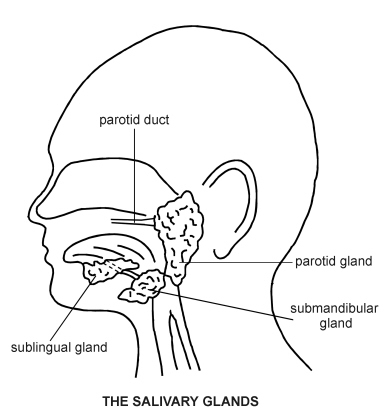
There are three main salivary glands, which come as a pair with one of each on each side of the face:
The parotid glands - situated just in front of your ear.
The submandibular glands - situated under your jaw line.
The sublingual glands - situated under your tongue.
Salivary gland disorders
What do my salivary glands do?
There are also several much smaller salivary glands dotted around your mouth. Tubes (ducts) carry the saliva from the gland into your mouth. The role of saliva in your mouth is to:
Keep it lubricated.
Help with speech.
Help with chewing and the start of the process of digesting your food.
Protect your teeth.
What are the causes of salivary gland disorders?
There is a wide range of possible causes for disorders of the salivary glands. Some of these are briefly discussed below.
Salivary gland infections
The most common infection which affects the salivary glands is mumps. This is an infection with a virus, most often affecting the parotid glands, although it can affect the other salivary glands. It usually affects both parotid glands, so the swelling is on both sides of your face; however, in some cases it is just one-sided.
Other viruses can affect the salivary glands too. Examples include:
Coxsackievirus.
Herpes viruses.
Influenza and parainfluenza viruses.
HIV.
Infections with bacteria can less commonly occur in the salivary glands. This is due to infection spreading from the mouth and is more common in people who are otherwise unwell with other problems. Tuberculosis occasionally affects the salivary glands.
Salivary gland stones
The chemicals in spit (saliva) can sometimes crystallise into a stone that can then block the salivary ducts. Some people form one or more small stones in a salivary gland. This occurs most commonly in people between the ages of 30 and 60 years, although it can occur at any age. Most stones occur in the tube (duct) which runs from the submandibular gland under the jaw. Stones block the duct, causing a backlog of saliva behind them, which results in a swelling.
Salivary gland tumours
When cells multiply out of normal control anywhere in the body, they cause a tumour which can be cancerous or non-cancerous. Tumours can occur in any of the salivary glands. Thankfully most tumours of salivary glands are not cancerous. About 8 out of 10 tumours are in the parotid gland, and about 8 out of 10 parotid tumours are not cancerous. All tumours need investigation, however, and most are removed with an operation.
Illness of other body systems
A generalised swelling of salivary glands can be caused by illness of other body systems (systemic illness). The most common of these is a condition called Sjögren's syndrome, which results in you having a very dry mouth.
Other illnesses which can cause swellings in the salivary glands include:
Sarcoidosis. This is a condition where tiny lumps (nodules), known as granulomas, develop at various sites within your body, due to inflammation. These granulomas are made up of cells involved in inflammation.
Cushing's syndrome. This is a condition caused by too much steroid in the body, either due to medication or to the body producing too much natural steroid.
Coeliac disease. This is caused by allergy to gluten.
Symptoms of salivary gland disorders
Possible symptoms suggesting salivary gland problems include:
Swelling of one or more gland. This would mean a swelling of part of your face. There may be redness (inflammation) of the skin over the swollen part.
Pain in the area of the salivary glands.
A dry mouth and throat.
A bad taste in the mouth.
A raised temperature (fever).
Which symptoms for which cause?
The pattern of symptoms helps to give a clue as to the cause. For example:
Where is the swelling?
We know where the salivary glands are, so a swelling in front of the ear suggests a problem with the parotid gland, whereas swelling along the line of the jaw suggests it is coming from the submandibular gland.
Are both sides of your face affected?
A stone or tumour is more likely to affect one gland and one side, whereas infection such as mumps usually (although not always) affects both sides. (In mumps, typically one side is swollen first, followed by the other a couple of days later.)
Does it come and go or is it constant?
Swellings caused by stones typically come on during or after eating, when saliva is flowing. They may then go down again. Pain and swelling which comes and goes is most likely to be caused by stones. In some cases, however, swelling caused by stones is there all the time (constant).
Is it painful?
Most causes can result in pain. However, infections, particularly those due to bacteria, tend to be particularly painful, whereas stones cause a dull pain which tends to come and go. Sometimes the swelling is painless.
Did it come on suddenly or gradually?
Stones and infections tend to cause a sudden swelling, whereas tumours tend to grow gradually over a period of weeks.
Is the swelling hard or soft?
Infections tend to cause softer swellings and tumours tend to be hard and very solid-feeling. However, most causes of salivary gland swelling can cause a solid-feeling lump.
Is taste or lubrication of the mouth affected?
Sjögren's syndrome causes you to have a dry mouth, as can infection. Infection may also cause a sensation of a bad taste in the mouth.
Do you feel generally unwell in yourself?
If you have a high temperature (fever) and feel generally unwell in yourself then the cause is more likely to be an infection.
Have you got any other symptoms?
Other symptoms in the rest of your body may suggest an underlying illness which is affecting the salivary glands. For example, dry eyes along with a dry mouth suggest Sjögren's syndrome. Extreme weight loss suggests anorexia. Gut symptoms might suggest coeliac disease, etc.
Should I see a doctor?
Yes, always consult a doctor if you think you have a problem involving your salivary glands. The doctor will be able to get a good idea of what might be the problem by listening to you and examining you. They may then wish to arrange some tests.
What tests might I have for a salivary gland disorder?
An ultrasound scan is often the first investigation for lumps in the salivary gland. This helps establish the type of swelling it is and gives an idea if it is likely to be caused by a stone or a tumour, for example.
If you are thought to have an infection, you may have a swab or a sample of the fluid in your mouth taken. (In the UK, mumps is a notifiable disease, so the diagnosis must be confirmed by the local Health Protection Team, who will provide a testing kit.) Blood tests may also be needed to help establish the type of infection.
Sialography is a special type of X-ray of the salivary glands and ducts. It involves injecting a chemical into the salivary duct to show it up on the X-ray. It is particularly useful for finding stones in the ducts or glands.
If an ultrasound shows a suspected tumour, further scans such as a magnetic resonance imaging (MRI) scan or a computerised tomography (CT) scan may be useful. An ultrasound or CT scan can also help guide a biopsy. In this procedure a sample of the swollen tissue is removed for examination under a microscope. This test would be used if a tumour were suspected from the results of other initial tests.
Tests on your saliva and tears are used to diagnose Sjögren's syndrome. Specific blood tests may also be helpful.
What is the treatment for salivary gland disorders?
This will entirely depend on the cause. See the separate leaflets on the individual conditions, where available, for details. Briefly, treatment of some of the more common causes is as follows:
Mumps
This gets better on its own over a week or so with no treatment. Paracetamol or ibuprofen may help with the symptoms. Avoid school or work for five days after symptoms start. See the separate leaflet called Mumps for more information.
Bacterial infections
These are treated with antibiotics. Encourage the flow of saliva by drinking enough fluid and by sucking lemon drops or chewing gum. Warm compresses may be helpful.
Stones
Many of these pass through the duct eventually on their own without needing any treatment at all. Others may need help from a specialist surgeon. Stones can be removed in a number of ways. See the separate leaflet called Salivary gland stones for more information.
Sjögren's syndrome
If you have been diagnosed with this condition you will usually be referred to a specialist in joint problems (a rheumatologist). This is because it tends to be associated with other conditions causing joint problems. The dry mouth symptoms are usually treated with artificial saliva products, or by advice about what you can do to encourage saliva to flow. This includes chewing gum, sucking lemon drops, and drinking enough fluid. Sometimes a medicine called pilocarpine is prescribed which encourages the salivary glands to produce more saliva. If you have Sjögren's syndrome, you should take extra good care of your teeth and visit your dentist regularly. See the separate leaflet called Sjögren's syndrome for more information.
Tumours
If you are thought to have a tumour in your salivary gland, you would be referred to a specialist team. Usually the tumour, or in some cases the entire salivary gland, is removed with an operation. Surgery may be followed by radiation therapy. The exact plan will depend on the type of tumour and where it is.
Are there any complications with salivary gland disorders?
Again, this depends on the individual diagnosis. Some complications of some salivary gland disorders include:
Mumps: in males there can be infection of the testicles (epididymo-orchitis) which can cause problems with fertility later in life. Occasionally the infection of mumps can spread to other parts of the body causing other problems.
Sjögren's syndrome: a number of complications are associated with this condition, including infections and tumours of the salivary glands, miscarriage in pregnant women, nerve problems and non-Hodgkin's lymphoma.
Stones: further stones may form in future. Blockage of the gland can result in infection or damage.
Tumours: operations to the parotid gland involve having to work around one of the main nerves of the face. If this is damaged, there can be weakness of one side of the face afterwards.
Any cause of damage to the salivary gland may result in long-term problems with its function. This can result in a dry mouth and problems with teeth.
Patient picks for Salivary glands

Children's health
Mumps
Mumps is an infection caused by a virus. It mainly affects the salivary glands, which are around the face. Sometimes other parts of the body are affected. Mumps normally affects children, but can occur at any age. Mumps is now uncommon in the UK as children are routinely immunised against mumps.
by Dr Philippa Vincent, MRCGP

Oral and dental care
Salivary gland stones
Salivary gland stones sometimes form in one of the salivary glands. These stones are small and form from chemicals in the saliva. A stone can cause a blockage of the flow of spit (saliva), which can lead to pain and swelling of the affected salivary gland. The reason why these stones form is not known. Sometimes a stone comes out into the mouth on its own, or with a gentle massage. However, a small procedure may be needed to remove the stone.
by Dr Toni Hazell, FRCGP
Frequently asked questions
Can I feel my submandibular gland?
Yes, the submandibular glands are situated under your jaw line. Therefore, if there's a problem affecting this gland, you might feel a swelling or lump in that area of your face.
What happens if a salivary gland completely stops producing saliva?
If a salivary gland stops functioning, it can lead to a dry mouth. This can cause problems with lubricating your mouth, speech, chewing, and the initial stages of digestion. It also removes the protective effect saliva has on your teeth, potentially leading to dental issues.
How are most salivary gland tumours treated?
Most salivary gland tumours are typically removed with an operation. In some cases, the entire salivary gland might be removed. Depending on the type and location of the tumour, surgery may be followed by radiation therapy.
Are there any long-term problems if a salivary gland is damaged?
Yes, any significant damage to a salivary gland can lead to long-term issues with its function, such as persistent dry mouth. This can also result in problems with your teeth due to the lack of saliva's protective qualities.
Can problems with my salivary glands affect other parts of my body?
Yes, some salivary gland disorders can have wider implications. For instance, mumps can potentially spread to other body parts, and in males, it can lead to infection of the testicles, which might affect fertility. Sjögren's syndrome, a condition causing dry mouth, is associated with a range of other complications, including infections, certain cancers, nerve problems, and issues during pregnancy.
Can certain eating habits affect my salivary glands?
Yes, eating disorders such as anorexia and bulimia are listed as conditions that can cause a generalised swelling of the salivary glands.
Further reading and references
- Wilson KF, Meier JD, Ward PD; Salivary gland disorders. Am Fam Physician. 2014 Jun 1;89(11):882-8.
- Mumps; NICE CKS, December 2023 (UK access only)
About the authorView full bio

Dr Mary Harding, MRCGP
General Practitioner, Medical Author
BA, MA, MB, BChir, MRCGP, DFFP
Dr Mary Harding qualified from Cambridge University medical school in 1989.
About the reviewerView full bio

Dr Colin Tidy, MRCGP
General Practitioner, Medical Author
MBBS, MRCGP, MRCP (Paediatrics), DCH
Dr Colin Tidy is an NHS Doctor, based in Oxfordshire.
Article history
Article also available in English, German, Spanish, French, Italian, Portuguese, Hindi, Hebrew, Arabic, and Swedish.
Next review due: 23 Oct 2027
24 Oct 2022 | Latest version
4 Jul 2017 | Originally published
Authored by:
Dr Mary Harding, MRCGP
Join the conversation
Share your thoughts or experiences with others in our patient communities.

Ask, share, connect.
Browse discussions, ask questions, and share experiences across hundreds of health topics.

Feeling unwell?
Assess your symptoms online for free
Sign up to the Patient newsletter
Your weekly dose of clear, trustworthy health advice - written to help you feel informed, confident and in control.
By subscribing you accept our Privacy Policy. You can unsubscribe at any time. We never sell your data.