Régurgitation mitrale
Revu par Dr Colin Tidy, MRCGPDernière mise à jour par Dr Hayley Willacy, FRCGP Dernière mise à jour 23 oct. 2023
Respecte les directives éditoriales
- TéléchargerTélécharger
- Partager
- Language
- Discussion
- Version audio
- Ajouter aux sources préférées sur Google
Dans cette série :Maladie des valves cardiaquesSténose mitraleSténose aortiqueRégurgitation aortiqueEndocardite infectieuse
The mitral valve is a heart valve that lies between the left atrium and left ventricle.
En un coup d'œil
Mitral regurgitation is a condition where the mitral valve in your heart does not close properly.
This causes blood to leak back into the left atrium when the heart pumps.
Mild mitral regurgitation often causes no symptoms.
More severe cases can cause shortness of breath, tiredness, and swollen ankles.
Medicines can help manage symptoms but cannot fix the valve.
Surgery to repair or replace the valve may be needed for more severe cases.
Treatment can greatly improve the outlook for people with the condition.
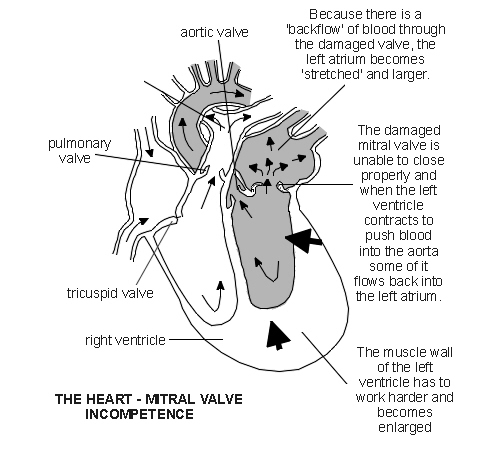
The heart - mitral valve incompetence
What is mitral regurgitation?
Mitral regurgitation is sometimes called mitral insufficiency or mitral incompetence. In mitral regurgitation the valve does not close properly. This causes blood to leak back (regurgitate) into the left atrium when the left ventricle squeezes (contracts). Basically, the more open the valve remains, the more blood regurgitates and the more severe the problem.
Prolapsus de la valve mitrale
This is also called floppy mitral valve. In this condition the valve is slightly deformed and bulges back into the left atrium when the ventricle contracts. This can let a small amount of blood leak back into the left atrium.
As many as 1 in 10 people have some degree of mitral valve prolapse. It becomes common with increasing age. It usually causes no symptoms, as the amount of blood that leaks back is often slight.
What causes mitral regurgitation?
Sometimes regurgitation is rarely caused by congenital structural deformity of or damage to the leaflets, chordae, and/or papillary heart muscles. It sometimes occurs with connective tissue disorders such as Marfan's syndrome, lupus érythémateux systémique ou Ehler's-Danlos syndrome.
Rheumatic heart disease is very common in the developing world and is a common cause of mitral regurgitation worldwide.
Mitral regurgitation symptoms
Mild mitral regurgitation may not cause any symptoms. However the symptoms associated with more severe mitral regurgitation include:
Essoufflement, especially with activity or when you lie down.
Swollen ankles (œdème).
Mitral regurgitation treatment
Mild cases may not require any regular medication. Although medicines cannot correct mitral regurgitation, some medicines may be prescribed to help ease symptoms, or to help prevent complications by managing your blood pressure - for example, Inhibiteurs de l'enzyme de conversion de l'angiotensine (ECA), 'water tablets' (diuretics) et anticoagulation medication.
If you develop fibrillation auriculaire, several medicines can be used to slow the heart rate down.
Traitement chirurgical
Surgical treatment is sometimes needed. Recent guidelines favour surgery at an earlier stage than used to be the case. The best option for you will depend on your particular circumstances.
Valve repair may be an option in some cases.
Valve replacement is needed in some cases. This may be with a mechanical or a tissue valve. Mechanical valves are made of materials which are not likely to react with your body, such as titanium. Tissue valves are made from treated animal tissue, such as valves from a pig.
Some surgical options may be possible through a catheter into the femoral vein. This avoids open heart surgery.
Recent guidelines favour replacement rather than repair in many cases. If you need surgery, a surgeon will advise on which is the best option for your situation.
What is the outlook for people with mitral regurgitation?
In some cases, the disorder is mild and causes no symptoms. If you develop symptoms they tend to become gradually worse over the years. Typical complications include une insuffisance cardiaque, pulmonary artery hypertension, fibrillation auriculaire et AVC. However, the speed of decline can vary. In many cases, it can take years for symptoms to become serious. Doctors use indications of how serious these complications are to decide when the best time is to refer for possible surgery. For example, when the pressure in the pulmonary artery rises above 60mmHg during exercise testing. Medication can ease symptoms but cannot repair a damaged valve.
Surgical treatment has greatly improved the outlook in most people with more severe regurgitation. Surgery has a very good success rate.
Sélections des patients pour Maladies cardiaques

Santé cardiaque et vaisseaux sanguins
Angine de poitrine
L'angine de poitrine est une douleur provenant du cœur. Elle est généralement causée par un rétrécissement des vaisseaux sanguins du cœur - les artères (coronaires). Le traitement habituel comprend un médicament statine pour réduire votre taux de cholestérol, de l'aspirine à faible dose pour aider à prévenir une crise cardiaque, et un bêta-bloquant pour protéger le cœur et prévenir les douleurs d'angine. Un médicament inhibiteur de l'enzyme de conversion de l'angiotensine (ACE) est conseillé dans certains cas. Parfois, une angioplastie ou une chirurgie sont des options pour élargir ou contourner les artères rétrécies.
par Dr Hayley Willacy, FRCGP

Santé cardiaque et vaisseaux sanguins
Maladie des valves cardiaques
Les valves cardiaques se trouvent entre les cavités du cœur et régulent le flux sanguin à travers le cœur. Il existe quatre types courants de problèmes de valves cardiaques : la sténose mitrale, l'insuffisance mitrale, la sténose aortique et l'insuffisance aortique. La fiche intitulée Anatomie du cœur comprend des détails sur la fonction du cœur et la façon dont il bat.
par Dr Philippa Vincent, MRCGP
Questions fréquemment posées
What is the difference between mitral regurgitation and mitral valve prolapse?
Mitral regurgitation means the mitral valve doesn't close properly, causing blood to leak backward into the left atrium when the left ventricle contracts. Mitral valve prolapse, also known as 'floppy mitral valve', is a condition where the valve is slightly deformed and bulges back into the left atrium. While mitral valve prolapse can cause a small amount of blood to leak back, leading to mitral regurgitation, they are distinct conditions.
Can mitral regurgitation be caused by conditions other than heart problems?
Yes, although rare, mitral regurgitation can sometimes be linked to congenital structural deformities of the valve components. It can also occur in individuals with some connective tissue disorders like Marfan's syndrome, systemic lupus erythematosus, or Ehlers-Danlos syndrome.
If I have mild mitral regurgitation and no symptoms, do I still need treatment?
Mild cases of mitral regurgitation may not require regular medication. While medicines cannot correct the valve problem, they can help manage symptoms or prevent complications, such as by controlling blood pressure, if needed.
What are the different types of valves used in surgical replacement?
When valve replacement surgery is needed, you might receive either a mechanical valve or a tissue valve. Mechanical valves are made from durable materials like titanium, designed not to react with your body. Tissue valves are crafted from treated animal tissue, such as valves sourced from pigs.
What factors do doctors consider when deciding if surgery is necessary for mitral regurgitation?
Doctors consider the severity of complications, such as heart failure, pulmonary artery hypertension, atrial fibrillation, and stroke, when determining the best time to refer for potential surgery. For instance, if the pressure in the pulmonary artery rises above 60mmHg during exercise testing, it suggests a need for intervention.
Lectures complémentaires et références
- Prophylaxie contre l'endocardite infectieuse : Prophylaxie antimicrobienne contre l'endocardite infectieuse chez les adultes et les enfants subissant des procédures interventionnelles; Ligne directrice clinique NICE (mars 2008 - dernière mise à jour juillet 2016)
- Nishimura RA, Otto CM, Bonow RO, et al; 2017 AHA/ACC Focused Update of the 2014 AHA/ACC Guideline for the Management of Patients With Valvular Heart Disease. Circulation. 2017; CIR.0000000000000503. Originally published March 15, 2017.
- Maladie des valves cardiaques chez les adultes : investigation et gestion; Directive NICE (novembre 2021)
- Girdauskas E, Pausch J, Harmel E, et al; Minimally invasive mitral valve repair for functional mitral regurgitation. Eur J Cardiothorac Surg. 2019 Jun 1;55(Suppl 1):i17-i25. doi: 10.1093/ejcts/ezy344.
- Aluru JS, Barsouk A, Saginala K, et al; Valvular Heart Disease Epidemiology. Med Sci (Basel). 2022 Jun 15;10(2):32. doi: 10.3390/medsci10020032.
À propos de l'auteurVoir la biographie complète

Dr Hayley Willacy, FRCGP
Médecin généraliste, Auteur médical
MBChB (1992), DRCOG, DFFP, MRCOG (Part 1) MRCGP (2007), DFSRH (2013), MSc - medical education (2020)
Le Dr Hayley Willacy était médecin généraliste au NHS travaillant dans le nord-ouest de l'Angleterre, qui a pris sa retraite de la pratique clinique en 2022 après 30 ans.
À propos du critiqueVoir la biographie complète

Dr Colin Tidy, MRCGP
Médecin généraliste, Auteur médical
MBBS, MRCGP, MRCP (Paediatrics), DCH
Le Dr Colin Tidy est un médecin du NHS, basé dans l'Oxfordshire.
Historique de l'article
Les informations sur cette page sont rédigées et examinées par des cliniciens qualifiés.
Article également disponible en Anglais, Allemand, Espagnol, Français, Italien, Portugais, Hindi, Hébreu, Arabe, and Suédois.
Next review due: 5 Sept 2028
23 oct. 2023 | Dernière version

Demandez, partagez, connectez-vous.
Parcourez les discussions, posez des questions et partagez vos expériences sur des centaines de sujets de santé.

Vous ne vous sentez pas bien ?
Évaluez vos symptômes en ligne gratuitement
Inscrivez-vous à la newsletter Patient
Votre dose hebdomadaire de conseils de santé clairs et fiables - rédigés pour vous aider à vous sentir informé, confiant et maître de la situation.
En vous abonnant, vous acceptez notre Politique de confidentialité. Vous pouvez vous désabonner à tout moment. Nous ne vendons jamais vos données.