
Le système reproducteur masculin
Revu par Dr Helen Huins, MRCGPDernière mise à jour par Dr Mary Harding, MRCGPDernière mise à jour 31 mai 2018
Respecte les directives éditoriales
- TéléchargerTélécharger
- Partager
- Language
- Discussion
- Version audio
- Ajouter aux sources préférées sur Google
Les organes et structures du système reproducteur masculin donnent aux hommes la capacité de féconder l'ovule d'une femme (ovule) pour concevoir un bébé.
Male reproductive system
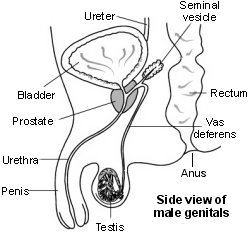
Several different organs and structures make up the male reproductive system. These include:
The scrotum, or scrotal sac. This is the loose bag of skin which hangs under the main body cavity between the upper thighs. It is divided into two, and each side contains one testicle (testis).
The testicles (testes). There are two testes. Each is an egg-shaped structure located in the scrotum. The testes produce sperm and also produce male hormones. The testes start developing inside the body cavity in a growing baby (fetus). About two months before a male baby is born, the testes start to drop down into the scrotal sacs. Because they are outside the main body cavity the testes are slightly cooler. This difference in temperature helps sperm production.
The epididymis. This is the tube attached to the testis where sperm is stored.
The vas deferens. This is the tube which carries the sperm from the epididymis. It may also be called the sperm duct. It meets a tube from the seminal vesicle (see below) to form a short tube called the ejaculatory duct. This then opens into the urethra, which is the tube that takes the sperm outside the body.
The accessory sex glands. There are three glands which produce fluids that mix with the sperm to make up semen. Semen is the liquid which is ejected from the penis during ejaculation. The three glands are located close to the bladder and are called:
The seminal vesicles
The prostate gland. The prostate gland lies just beneath the bladder (see diagram). It is normally about the size of a chestnut.
The bulbourethral glands
The penis. The penis has a single tube in it called the urethra. There are three main parts of the penis - the root, body and glans. The root is the part attached to the skin at the top of the scrotum. The body of the penis is made up of a spongy type of tissue, which swells when blood enters during an erection. The glans penis is the slightly larger area towards the end of the penis and contains the opening of the urethra.
The urethra. This is the tube which passes from the bladder down the penis to the outside. It carries both urine and semen.
What does the male reproductive system do?
The main function is to give men the ability to fertilise a woman's egg (ovum) by producing and delivering semen. The testicles (testes) also make hormones which help men develop the characteristics associated with being male. This includes:
The development of hair in a male distribution - for example, on the chest, under the arms, on the face and in the pubic area.
Enlargement of the penis.
Deepening of the voice.
Muscle growth.
Bone growth and increased height.
How does the male reproductive system work?
During puberty, the level of a hormone called gonadotrophin-releasing hormone (GnRH) increases. GnRH is produced in a part of the brain called the hypothalamus. In turn this causes an increase in the production of two hormones from another part of the brain, called the pituitary gland. These hormones are called luteinising hormone (LH) and follicle-stimulating hormone (FSH). LH in the bloodstream causes cells in the testicles (testes) to make and release testosterone, the main male hormone.
FSH and testosterone work together to stimulate the testes to produce sperm. Each sperm cell takes between 65-75 days to form and around 300 million are produced every day. Inside the testes sperm is made in structures called the seminiferous tubules. At the top and to the back of each testicle (testis) is the epididymis, which stores sperm.
Leading from the epididymis is the vas deferens. The vas deferens carries sperm towards the penis. Along the way it joins other tubes and during ejaculation collects fluids from the accessory sex glands. The mixture of sperm and fluids from the accessory sex glands is called semen. About two thirds of the volume of semen come from the seminal vesicles. The semen is then passed into the urethra.
When sexually aroused, a number of changes occur inside the penis. The arteries supplying the penis get bigger, allowing more blood to enter its tissues. The extra blood flow causes the penis to enlarge and to become more rigid. The extra blood flow plus signals from the nervous system and chemical changes cause an erection.
Ejaculation is the term for the contractions that release semen. This is a reflex action, which means it is not consciously controlled. As part of the reflex action, the opening that drains the bladder is closed. This means that urine is not released at the same time as semen. The volume of semen in a typical ejaculation is between 2.5-5 millilitres (mL). There are normally more than 20 million sperm in each mL of semen. During sexual intercourse, the penis of the male enters the vagina of the female, carrying the sperm to the neck of the womb (cervix) to fertilise the woman's egg.
Some disorders of the male reproductive system
Sélections des patients pour la santé sexuelle masculine

Santé sexuelle
Ce que la dysfonction érectile pourrait signifier pour votre cœur
Erectile dysfunction (ED) - or impotence - is when a man has trouble either getting or maintaining an erection. It's extremely common, with up to half of 40-70 year olds experiencing it to some degree. Despite this, many men find it difficult to talk about and so suffer in silence, not wanting to bother their GP. The fact that Viagra® is now easily accessible online or over the counter without a prescription means many self-treat without support. But what most don't realise is that such behaviour could spell bad news for their heart.
par Dr Anna Cantlay, MRCGP

Santé sexuelle
Ce que vous devez savoir avant de prendre des médicaments pour la dysfonction érectile
Vous pouvez désormais acheter des médicaments contre la dysfonction érectile (DE) en vente libre dans les pharmacies. Cependant, certains hommes feraient mieux de consulter leur médecin généraliste d'abord, car le dosage et les options de traitement peuvent nécessiter des ajustements, et une DE persistante peut être un signe précoce de maladie cardiovasculaire et d'autres problèmes de santé.
par Sally Turner
À propos de l'auteurVoir la biographie complète

Dr Mary Harding, MRCGP
Médecin généraliste, Auteur médical
BA, MA, MB, BChir, MRCGP, DFFP
Le Dr Mary Harding a obtenu son diplôme de l'école de médecine de l'Université de Cambridge en 1989.
À propos du critiqueVoir la biographie complète

Dr Helen Huins, MRCGP
Médecin généraliste, Auteur médical
MB, BS, Lond, DCH, DRCOG, MRCGP, JCPTGP, DFFP
Helen a obtenu son diplôme à l'hôpital Guy's en 1989 et a quitté Londres en 1990 pour s'installer à la campagne.
Historique de l'article
Les informations sur cette page sont examinées par des cliniciens qualifiés.
Article également disponible en Anglais, Allemand, Espagnol, Français, Italien, Portugais, Hindi, Hébreu, Arabe, and Suédois.
31 mai 2018 | Dernière version

Demandez, partagez, connectez-vous.
Parcourez les discussions, posez des questions et partagez vos expériences sur des centaines de sujets de santé.

Vous ne vous sentez pas bien ?
Évaluez vos symptômes en ligne gratuitement
Inscrivez-vous à la newsletter Patient
Votre dose hebdomadaire de conseils de santé clairs et fiables - rédigés pour vous aider à vous sentir informé, confiant et maître de la situation.
En vous abonnant, vous acceptez notre Politique de confidentialité. Vous pouvez vous désabonner à tout moment. Nous ne vendons jamais vos données.
Plus sur la santé sexuelle
- Les femmes peuvent-elles prendre du Viagra ?
- Démystifier les idées reçues sur le VIH et le SIDA
- Les stéroïdes anabolisants causent-ils l'infertilité ?
- La contraception hormonale affecte-t-elle la fertilité après l'arrêt de son utilisation ?
- Le cancer des testicules affecte-t-il votre fertilité ?
- Comment la maladie de Crohn peut affecter votre vie sexuelle
- Quelle est l'efficacité du PEP pour prévenir le VIH ?
- À quelle vitesse les différentes IST se propagent-elles ?
- Vivre avec le VIH depuis la naissance
- Sexe oral : ce que vous devez savoir pour rester en bonne santé
- La meilleure façon de traiter une poussée d'herpès
- Le système reproducteur féminin
- Les bienfaits des jouets sexuels pour la santé
- Que font les universités pour soutenir la santé sexuelle des étudiants ?
- Qu'est-ce qui peut causer une odeur vaginale après un rapport sexuel ?
- Que se passe-t-il lorsque vous arrêtez la pilule ?
- Que faire concernant la contraception après l'accouchement
- Ce que les jeunes veulent vraiment de l'éducation sexuelle
- Quand redeviendrai-je fertile après avoir arrêté la contraception ?
- Pourquoi les contrôles réguliers des IST sont si importants