Ganglions lymphatiques enflés
Revu par Dr Hayley Willacy, FRCGP Dernière mise à jour par Dr Doug McKechnie, MRCGPDernière mise à jour 23 août 2023
Respecte les directives éditoriales
- TéléchargerTélécharger
- Partager
- Language
- Discussion
- Version audio
Dans cette série :Neck lumps and bumps
Swollen lymph glands (also called lymph nodes) are usually a sign that your body is fighting infection, but they can have other causes. Common areas for swollen glands include the neck, under the chin, in the armpits and in the groin. Swollen lymph glands caused by infection usually get better on their own within two weeks. In this leaflet we discuss what causes swollen glands, how to check if your glands are swollen, and what to do if you think you have swollen glands.
Dans cet article:
Sélections de vidéos pour Le système immunitaire
Points clés
Swollen lymph glands are painful, tender lumps that can appear on each side of the neck, in the armpits, under the chin, and around the groin. They are usually a sign that your body is fighting off an infection.
You may have other symptoms, such as a sore throat, a high temperature, or a cough. Sometimes only a gland on one side of the neck may swell.
Swollen lymph glands can get better within 1-2 weeks by resting, drinking plenty if fluids, and taking pain relief. If your glands haven't gone down after 2 weeks, are getting bigger, or you are struggling to breathe, you should seek medical help immediately.
What are swollen glands?
Continuez à lire ci-dessous
What are lymph glands?
Detail of lymph gland names
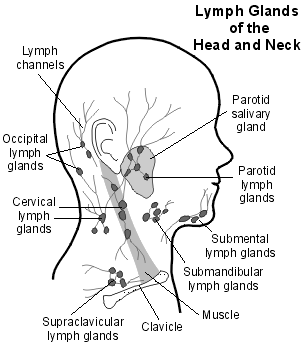
Small lymph glands (also called lymph nodes) are found all throughout the body. Lymph glands that are near each other often form into groups or chains. Examples of where lymph glands group together are the sides of the neck, the armpits and the groins. The diagram shows the main groups of lymph glands in the head and neck. However, lymph glands occur in many other places in the body.
Lymph glands are joined together by a network of lymph channels. Lymph is a fluid that forms between the cells of the body. This watery fluid travels in the lymph channels, through various lymph glands, and eventually drains into the bloodstream.
Lymph and lymph glands are major parts of the immune system. They contain white blood cells (lymphocytes) and antibodies that defend the body against infection.
What do swollen lymph glands feel like?
Retour au sommaireLymph glands are normally pea-sized. You can sometimes feel them as lumps under the skin. People often feel their lymph glands in the neck. Lymph glands under the skin become more noticeable and easier to feel if they swell. They can swell to the size of marbles or even bigger.
You cannot see or feel lymph glands that are deeper in the chest or tummy (abdomen) but they may be uncomfortable or tender.
Continuez à lire ci-dessous
What causes swollen lymph glands?
Retour au sommaireCauses of swollen lymph glands include the following:
Infection - the common cause
The lymph glands near to an infection swell quickly and become tender as the immune system 'fights off' infecting germs (bacteria, viruses, etc). The lymph glands usually go back to their normal pea size when the infection is over. It can take a week or so for them gradually to go back to normal after the infection. Tender, swollen lymph glands are usually a sign that your body is fighting off an infection. Examples of infections include the following:
Throat infections, amygdalite, le common cold (one type of upper respiratory infection) and tooth-related infections may cause lymph glands in the neck to swell.
Scalp skin conditions or even head lice may cause the lymph glands at the back of the head to swell.
Skin infections of the arm may cause lymph glands in the armpit to swell.
Infections of the leg or genitals, or l'érythème fessier, may cause lymph glands in the groin to swell.
Viral infections such as flu (influenza), varicelle ou fièvre glandulaire (mononucléose infectieuse) affect the whole body. You may then develop swollen lymph glands in various parts of the body such as the neck, armpit and groins.
Cancers, lymphomas and leukaemias - the less common causes
Some cells from a cancer can break off and spread (metastasise) to nearby lymph glands via the lymph channels. These cancer cells then grow and multiply in the lymph glands and cause the glands to swell. For example:
le cancer du sein may spread to the lymph glands in the armpit.
Throat cancer may spread to lymph glands in the neck.
Lung et stomach cancers may spread to lymph glands that you usually cannot see or feel in the chest and abdomen.
Skin cancers may spread first to the closest lymph glands to the area of skin involved.
Cancer of the lymphatic and blood systems (lymphome non hodgkinien, Lymphome de Hodgkin et leucémies) can cause many lymph glands to swell.
As a rule, swollen lymph glands due to cancers, lymphomas and leukaemias develop more slowly than those due to infections. They also tend to be painless at first.
Other less common causes
Rarely, swollen lymph glands can be due to causes such as:
Reactions to certain medicines.
Operative dental work.
Glycogen storage disorders.
Certain forms of arthritis, such as polyarthrite rhumatoïde.
Less common infections, such as VIH, la maladie de Kawasaki et la tuberculose (TB).
How to treat swollen lymph glands
Retour au sommaireThe treatment depends on the cause. Swollen lymph glands are like a marker of various conditions, all with different outlooks and treatments. So, for example, the common cause is due to a viral infection. In this case, no treatment is needed: the lymph glands will go back to normal after a week or so. However, swollen lymph glands caused by a cancer, lymphoma or leukaemia may need extensive treatment of the underlying problem.
Continuez à lire ci-dessous
What should I do if I find swollen lymph glands?
Retour au sommaireSwollen lymph glands due to viral infections are very common. It's normal to get these with an infection - they're a sign that your body is fighting it off. For example, swelling of neck lymph glands may go up and down if you have frequent throat infections. This is of little concern. However, you should see your doctor if your lymph glands have not gone down after two weeks.
Swollen lymph glands are more of a concern if there is no apparent reason for them to swell. Tell your doctor if:
You find swollen lymph glands and you do not know why they have swollen. For example, you do not have an infection to cause them to swell.
You find swollen lymph glands just above or just below your collar bone (clavicle). Swollen glands in this area are more likely to suggest a cause for concern.
You have swollen lymph glands that have been there for two weeks or longer.
Questions fréquemment posées
Retour au sommaireAre swollen glands a symptom of cancer?
Swollen glands can be a sign of cancer, however, they are most likely to be caused by an infection. You should see your doctor if they are hard, painless, and haven't gone away after two weeks.
What drink helps swollen glands?
Drinks including warm teas, honey with lemon water, and normal water can soothe irritation caused by swollen glands and keep you hydrated.
Can stress cause swollen glands?
Stress itself does not cause swollen glands but it can weaken your immune system - making you more prone to infections and developing swollen glands.
Can hay fever cause swollen glands?
Hay fever can sometimes cause swollen glands. Whilst it's not a common symptom of hay fever, it is possible. You should see your doctor to rule out other causes.
Sélections de patients pour Le système immunitaire
Allergies, sang et système immunitaire
Immunosuppression
L'immunosuppression décrit une perte de fonction immunitaire. Elle peut survenir pour de nombreuses raisons, notamment la maladie, les médicaments, la chirurgie, l'âge ou la génétique.
par Dr Philippa Vincent, MRCGP

Allergies, sang et système immunitaire
Le système immunitaire
Ce dépliant donne un aperçu bref du système immunitaire et de son fonctionnement. Une personne avec un système immunitaire faible peut avoir des difficultés à combattre les infections. Dans les maladies auto-immunes, le corps est incapable de distinguer ce qui lui appartient de ce qui est étranger, donc il s'attaque lui-même. Les maladies auto-immunes peuvent attaquer n'importe quelle partie du corps - par exemple, le diabète de type 1 (pancréas), la sclérose en plaques (cerveau et nerfs), le lupus érythémateux systémique (peau et organes). Ces maladies sont gérées par le spécialiste qui connaît le mieux le système affecté pour cette personne - par exemple, la sclérose en plaques est gérée par un neurologue.
par Dr Toni Hazell, MRCGP
Lectures complémentaires et références
- Richner S, Laifer G; Peripheral lymphadenopathy in immunocompetent adults. Swiss Med Wkly. 2010 Feb 20;140(7-8):98-104.
- Neck lump; NICE CKS, October 2020 (UK access only)
- Pynnonen MA, Gillespie MB, Roman B, et al; Clinical Practice Guideline: Evaluation of the Neck Mass in Adults. Otolaryngol Head Neck Surg. 2017 Sep;157(2_suppl):S1-S30. doi: 10.1177/0194599817722550.
Continuez à lire ci-dessous
Historique de l'article
Les informations sur cette page sont rédigées et examinées par des cliniciens qualifiés.
Prochaine révision prévue : 21 août 2028
23 août 2023 | Dernière version

Demandez, partagez, connectez-vous.
Parcourez les discussions, posez des questions et partagez vos expériences sur des centaines de sujets de santé.

Vous ne vous sentez pas bien ?
Évaluez vos symptômes en ligne gratuitement
Inscrivez-vous à la newsletter Patient
Votre dose hebdomadaire de conseils de santé clairs et fiables - rédigés pour vous aider à vous sentir informé, confiant et maître de la situation.
En vous abonnant, vous acceptez notre Politique de confidentialité. Vous pouvez vous désabonner à tout moment. Nous ne vendons jamais vos données.