Osmolality, osmolarity and fluid homeostasis
Peer reviewed by Dr Colin Tidy, MRCGPLast updated by Dr Hayley Willacy, FRCGP Last updated 23 Oct 2023
Meets Patient’s editorial guidelines
- DownloadDownload
- Share
- Language
- Discussion
- Audio Version
- Add to preferred sources on Google
Osmolality is a measure of the number of particles in a kg of the liquid they are dissolved in. Osmolarity is a measure of the number of particles in a litre of the liquid they are dissolved in. Fluid homeostasis is the term for keeping the concentration of the fluids in the body from changing. It is sometimes also referred to as fluid balance.
At a glance
Fluid homeostasis is how the body keeps its fluid concentration levels stable.
Osmolality measures the number of particles per kilogram in a fluid.
The normal osmolality level for serum is 280-295 mOsm/kg.
Your body makes you thirsty and releases ADH when osmolality gets too high.
If osmolality gets too low, your body reduces ADH and you pass more urine.
Our bodies manage millions of chemical reactions every day. These reactions depend on the concentration of the fluid in our cells and our blood being tightly controlled all day, every day. How does it do this? By making us thirsty, for instance, when the fluid is tending to become more concentrated and making us pass more urine when it's getting less concentrated.
Sometimes when you are ill, however, your body's natural balance mechanisms become upset. In these situations, you may need to have regular blood monitoring and treatment to correct imbalances.
To understand fluid homeostasis it helps to understand some of the terms that are used when talking about fluid balance. Osmolality and osmolarity are terms to describe how concentrated the body fluids are.
What is osmolality?
The osmolality of a fluid is a measure of the number of particles per kilogram of the liquid that they are dissolved in (the solute). The number of particles is measured in milliosmoles, which is a measurement widely used in chemistry. The measurement is given in milliosmoles per kilogram, or mOsmol/kg for short.
Osmolality does not depend on the temperature of the liquid. To take an example, if you dissolve 100 g of salt in 1 kg of water, the osmolality would be the same whether or not the water was near freezing point or at body heat. This is the difference between osmolality and osmolarity.
What is osmolarity?
The osmolarity of a fluid is a measure of the number of particles per litre of the liquid that they are dissolved in (the solute). The number of particles is measured in millimoles, which is another measurement widely used in chemistry. The measurement is given in millimoles per litre, or mmol/L for short.
Osmolarity will change depending on the temperature of the liquid. To take the same example as above, if you dissolve 100 g of salt in 1 kg of water, the osmolarity will decrease very slightly as the liquid warms up. This is because the same weight of water takes up slightly more room as it warms up - it expands.
Because osmolarity changes with temperature, the term osmolality is preferred in medicine.
Why is osmolality measured?
Osmolality is measured when doctors are concerned that your fluid balance may have gone awry for some reason. This might be due to an illness or as a side-effect of medication. It may even be due to you having overloaded your system by drinking too much water.
They may also want to measure it to monitor the effects of medication designed to change the osmolality of your body tissues. Mannitol is used for this effect to reduce brain swelling if you have had a head injury or brain surgery.
What is a normal osmolality level?
The body fluid that we usually use to measure osmolality in humans is serum. Serum is what is left from blood once the cells and proteins have been removed. The particles that make up the osmolality of serum are glucose, sodium and potassium salts (Na+ and K+) and urea. The normal serum osmolality is 280-295 mOsm/kg. Often you will be asked for a sample of urine for urine osmolality testing too.
The serum osmolality is extremely close to the osmolality inside the cells that our body is made of. This is because the walls of our cells are permeable to the microscopic particles (ions and anions) and to water.
Permeable means it allows these particles and water to move freely in and out through the cell walls. This keeps the osmolality the same on both sides of the cell walls throughout the body. This is important as the cells won't work properly if this doesn't happen.
Occasionally the osmolality of stools (faeces) may also be tested.
What is fluid homeostasis?
Fluid homeostasis is the term for the way the body keeps the osmolality of the body fluids within a very narrow range, all the time. The word homeostasis comes from 'homeo' meaning alike or similar and 'stasis' meaning to remain the same. So fluid homeostasis means keeping the fluid the same all the time.
How does the body maintain fluid homeostasis?
In normal, healthy people the osmolality of the body's fluids is very closely regulated by the body.
As the osmolality goes up
You get a desire to drink - thirst.
The brain releases a hormone called antidiuretic hormone (ADH) (also known as arginine vasopressin (AVP)).
ADH changes the way the kidneys react to blood flowing through them.
The kidneys are continuously filtering the blood and can alter how much water is allowed to go into the urine and how much is reabsorbed back into the body.
Diuretic essentially means 'to make you pass urine', so antidiuretic hormone (ADH), as the name suggests, stops you making as much urine and so you don't pass as much urine. The urine you do pass will be darker in colour, as it is more concentrated.
If you don't pass as much urine, you don't lose as much water.
If you don't lose as much water and you have a drink because you are thirsty, there is more water in your body.
If there is more water in your body, your osmolality goes down.
As the osmolality goes down
The brain stops releasing ADH and you stop feeling thirsty.
The kidneys start making more urine again.
You pass more diluted urine.
You lose more water from your body.
If there is less water in your body, your osmolality goes up again.
And so it continues, all day, every day: your brain and your kidneys tightly controlling the environment inside your cells.
Do you need eight glasses of water a day?
Sometimes. Sometimes not. It depends on what you are doing, how hot it is, how big you are, how old you are ... but your body will tell you if you need a drink, by making you thirsty.
There is a myth that we need to drink 1½ to 2 litres of water a day. It's not known where this figure comes from but it has been described as: 'not only nonsense but ... thoroughly debunked nonsense.' It's certainly a favourite of the bottled water industry.
Drinking water is definitely better for us than drinking sugary drinks, but for those of us lucky enough to be living in the advanced world, water supplies are closely monitored and very safe.
Except for people who get recurrent kidney stones, there is no evidence that we should drink more than we naturally want. It may even be bad for us: if it makes us feel guilty for not achieving it - and that's not to mention the sleep deprivation from having to get up in the middle of the night, and the urinary incontinence.
How does fluid homeostasis go wrong?
There are some conditions and situations when fluid homeostasis can go wrong. The effects can be for osmolality to go too high (hyperosmolality) or too low (hypo-osmolality).
What causes high
Not enough antidiuretic hormone (or it has lost its effect)
Diabetes insipidus:
This is not to be confused with diabetes mellitus, which is much more common.
Diabetes insipidus is due either to the brain not being able to make antidiuretic hormone (ADH) anymore (cranial diabetes insipidus) or the kidneys losing their ability to react to it (nephrogenic diabetes insipidus).
It can cause severe lack of fluid in the body (dehydration).
Loss of body fluid
Some medicines such as diuretics - for example, thiazide diuretics or loop diuretics - can overwhelm the kidneys' ability to hold back water.
Severe diarrhoea.
Severe sickness (vomiting).
Excessive sweating.
Burns.
What causes low osmolality?
Too much antidiuretic hormone
Neurological causes: brain cancer and brain tumours, brain injury, multiple sclerosis, systemic lupus erythematosus, bleeding into the brain.
Lung disorders: lung cancer, pneumonia, asthma, tuberculosis.
Other cancers: stomach cancer, pancreatic cancer, leukaemia and lymphoma.
Some medicines:
Non-steroidal anti-inflammatory drugs (NSAIDs) - for example, ibuprofen.
Selective serotonin reuptake inhibitors (SSRIs) - for example, fluoxetine.
Proton pump inhibitors - for example, omeprazole.
Angiotensin-converting enzyme (ACE) inhibitors - for example, lisinopril.
Ecstasy (also called MDMA): increases ADH but also users tend to drink excessively, possibly to counter the other effect of ecstasy, which is to increase body temperature.
Exercise - see below.
Drinking too much water
Drinking an excessive amount of water can overwhelm the body's fluid homeostasis, leading to water intoxication.
It has occurred in people who are drinking to excess in an effort to feel full when trying to lose weight.
Water intoxication has also resulted from water drinking competitions and 'initiation' ceremonies.
It can occur with exercise, in which case it is called exercise-associated hyponatraemia (EAH):
This has been a particular problem with marathon runners, who worry so much about not drinking enough that they drink too much.
Exercise is a trigger for ADH release and this will worsen the effects of drinking too much.
Some people unwisely use an anti-inflammatory painkiller before any sporting activity, which will make EAH even more likely.
It has recently been reported after less demanding exercise, including yoga.
The effect of these problems is due to the very low osmolality of sodium (Na+). This is called hyponatraemia and when severe, can lead headache, dizziness, disorientation and confusion. Ultimately it can lead to coma and death.
For more information, see the separate leaflet called Hyponatraemia.
Patient picks for Blood tests
Tests and investigations
Antibody and antigen tests
Antibodies are part of the body's defence (immune) system. Antigens are the particles that cause the body to create an antibody. Tests to detect antibodies and antigens help to identify certain infections and some other medical conditions.
by Dr Toni Hazell, FRCGP
Tests and investigations
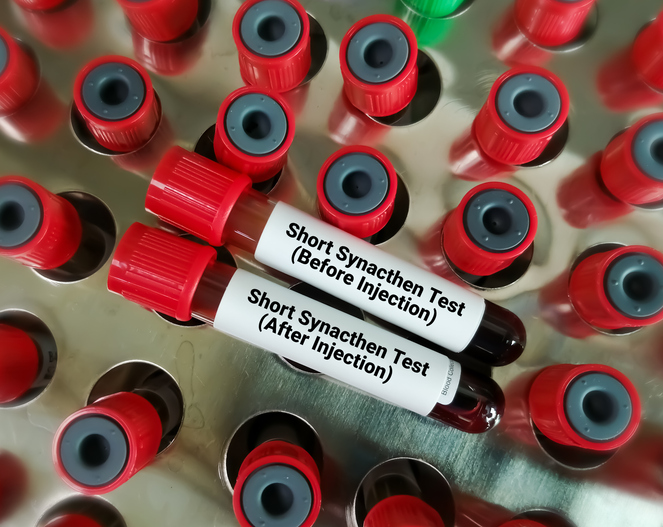
Synacthen test
A synacthen test checks the function of the adrenal glands. It can help to see whether the adrenal glands are producing enough steroid hormone (cortisol). Note: the information below is a general guide only. The arrangements, and the way tests are performed, often vary between different hospitals. Always follow the instructions given by your doctor or local hospital.
by Dr Philippa Vincent, MRCGP
Frequently asked questions
What is the difference between osmolality and osmolarity?
Osmolality measures the number of particles per kilogram of liquid, and it does not change with temperature. Osmolarity measures the number of particles per litre of liquid, and it can change slightly with temperature. Because osmolarity is affected by temperature, osmolality is the preferred measurement in medicine.
Why is osmolality measured in medicine?
Osmolality is measured when doctors suspect an imbalance in your body's fluid levels, which can be caused by illness, medication side effects, or even drinking too much water. It can also be monitored to check the effectiveness of treatments designed to adjust fluid balance, such as medication used to reduce brain swelling after an injury or surgery.
What components contribute to the osmolality of my blood serum?
The main particles that contribute to the osmolality of your blood serum are glucose, sodium (Na+) and potassium (K+) salts, and urea.
Can drinking too much water be dangerous?
Yes, drinking an excessive amount of water can overwhelm your body's fluid balance system, potentially leading to a dangerous condition called water intoxication. This can severely lower your blood sodium levels (hyponatraemia), causing symptoms like headache, dizziness, disorientation, and confusion, and in severe cases, it can lead to coma or be fatal. This risk is particularly noted in situations like endurance sports, water drinking competitions, or sometimes when trying to lose weight.
What does 'fluid homeostasis' mean for my body?
Fluid homeostasis means that your body actively works to keep the concentration of fluids in your cells and blood within a very narrow, healthy range at all times. This constant balance is crucial for your cells to function correctly. This process usually involves mechanisms like thirst and the regulation of urine production by the kidneys.
Further reading and references
- McCartney M; Waterlogged? BMJ. 2011 Jul 12;343:d4280. doi: 10.1136/bmj.d4280.
- Hew-Butler T, Loi V, Pani A, et al; Exercise-Associated Hyponatremia: 2017 Update. Front Med (Lausanne). 2017 Mar 3;4:21. doi: 10.3389/fmed.2017.00021. eCollection 2017.
- Hyponatraemia; NICE CKS, November 2020 (UK access only)
- Shah MM, Mandiga P; Physiology, Plasma Osmolality and Oncotic Pressure.
- Darwish A, Lui F; Physiology, Colloid Osmotic Pressure.
About the authorView full bio

Dr Hayley Willacy, FRCGP
General Practitioner, Medical Author
MBChB (1992), DRCOG, DFFP, MRCOG (Part 1) MRCGP (2007), DFSRH (2013), MSc - medical education (2020)
Dr Hayley Willacy was an NHS GP working in northwest England, who retired from clinical practice in 2022 after 30 years.
About the reviewerView full bio

Dr Colin Tidy, MRCGP
General Practitioner, Medical Author
MBBS, MRCGP, MRCP (Paediatrics), DCH
Dr Colin Tidy is an NHS Doctor, based in Oxfordshire.
Article history
The information on this page is written and peer reviewed by qualified clinicians.
Article also available in English, German, Spanish, French, Italian, Portuguese, Hindi, Hebrew, Arabic, and Swedish.
Next review due: 21 Oct 2028
23 Oct 2023 | Latest version
Join the conversation
Share your thoughts or experiences with others in our patient communities.

Ask, share, connect.
Browse discussions, ask questions, and share experiences across hundreds of health topics.

Feeling unwell?
Assess your symptoms online for free
Sign up to the Patient newsletter
Your weekly dose of clear, trustworthy health advice - written to help you feel informed, confident and in control.
By subscribing you accept our Privacy Policy. You can unsubscribe at any time. We never sell your data.