Avez-vous vraiment besoin de marcher 10 000 pas par jour ?
Revu par des pairs par Dr Colin Tidy, MRCGPDernière mise à jour par Lawrence HigginsDernière mise à jour 28 juil. 2025
Respecte les directives éditoriales
- TéléchargerTélécharger
- Partager
- Language
- Discussion
- Version audio
- Ajouter aux sources préférées sur Google
Are you wearing a device like a smartwatch to track your steps? If so, the goal of 10,000 steps a day may have become a bit of an obsession. But is focusing on this number the best way to improve your health? We ask an expert whether all this counting is really doing us any good.
In the 1960s, in the lead up to the Tokyo Olympics, the pedometer was first marketed as a fitness device. One Japanese company developed a product called 10,000 steps - translated into English. Decades later, the default setting on smart-watches and health apps is this magic number. But there's really no medical reasoning for its introduction.
Brisk walking
Of course, 10,000 steps is an easy number to remember but it's also a challenge for most people - as it equates to around five miles. And it might not be the best way to improve your health.
According to GP Dr Zoe Williams, clinical champion of physical activity at the Royal College of GPs, we need to be focusing more on speed than steps.
"What is most important is the speed at which you walk," she reveals. "You could achieve 10,000 steps but at a slow, strolling pace. This won't raise your heart rate so the health benefits would be minimal. Brisk walking - defined as at least 3 mph - is the key. Walking for around 10 minutes briskly gives health benefits."
In 2023, the largest ever study1 of its kind found that 11 minutes of brisk walking - at moderate-intensity - could prevent one in 10 early deaths worldwide. But most of us won't have a clue how fast we're walking. So how can we tell if our walking is enough to improve our health?
Williams explains: "If you walk briskly, your heart rate is faster, you breathe faster and you may feel a bit sweaty. You should still be able to hold a conversation without being out of breath. We call this moderate activity."
It can still be hard to know how much you are challenging yourself when you walk, but there is a free NHS App called Active 10 which monitors your walking and speed. Just one brisk 11-minute walk every day provides significant benefit. And if you can increase that number to three a day, you will have achieved one of the five moderately active sessions per week that is recommended for health.
Williams says: "Many people don't realise that regular brisk walking can reduce their risk of cancer by a significant amount."
So it's well worth picking up the pace.
Are 7,000 steps enough?
Research published in the Lancet2 found that the health benefits from walking tended to level off beyond 7,000 steps – although that does not mean you are not still gaining from walking further.
The research found that compared to those who walked 2000 steps per day, people who walked 7,000 steps per day had a 47% lower risk of dying from heart or blood vessel (cardiovascular) diseases and 37% of dying from cancer.
Other findings included lower risks of developing several conditions, including:
Cancer - down 6%.
Dementia - down 38%.
Depression - down 22%.
Heart disease – down 25% down.
Type 2 diabetes – down 14%.
It was also found that people were less likely to have falls.
The research found that walking even around 4,000 steps a day had several health benefits compared to walking 2,000 steps a day.
The study concluded that whilst 10,000 steps per day can still be a viable target for more active people, 7,000 steps per day is associated with meaningful improvements in health outcomes and might be a more realistic and achievable target for many.
How to be more active
One of the main reasons people give for not walking enough, according to Williams, is lack of time. But she believes exercise can be incorporated into your day-to-day life quite easily.
Start small
Small, healthy choices can add up. Some of Williams' suggestions include:
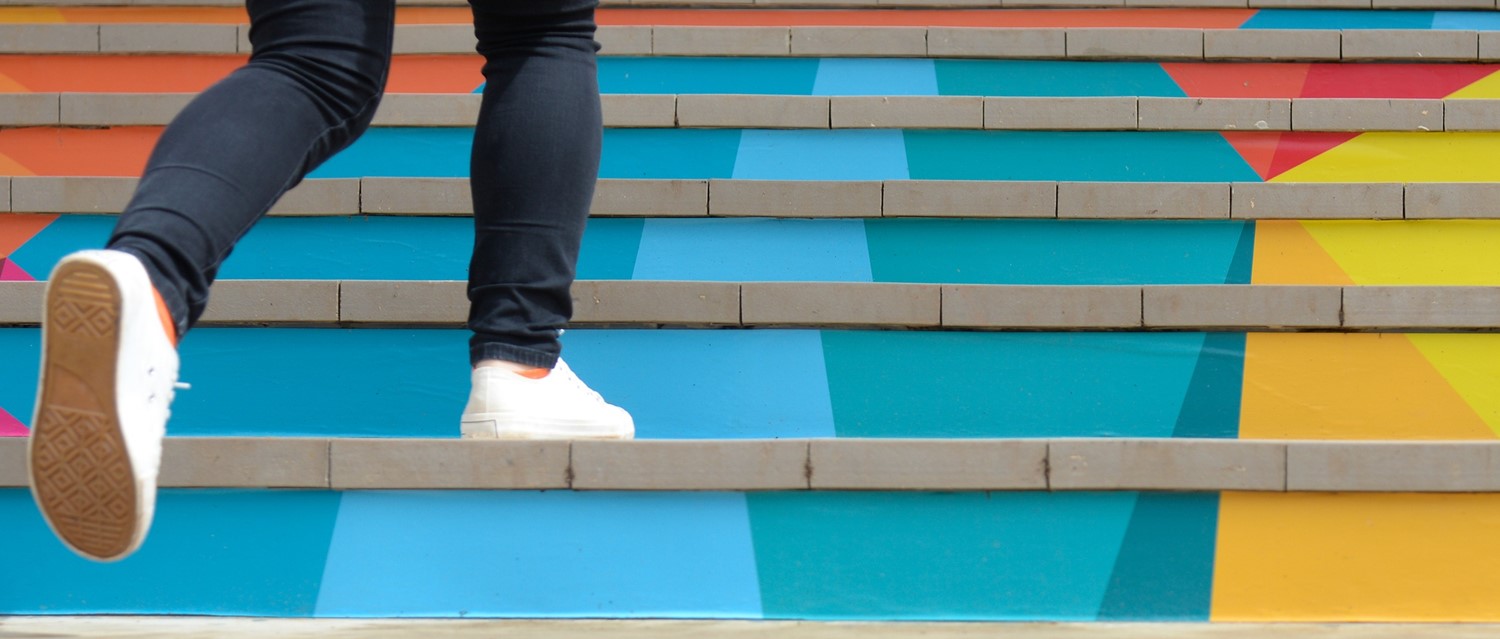
Take the stairs instead of the lift.
If you have to use an escalator, walk up it, don't stand still.
Park your car furthest away from the supermarket door - pushing your trolley is good exercise too.
If your journey to work or the school run is under a mile, then walk or cycle.
If your work is sedentary, try to fit in a quick 15-minute walk at lunchtime.
You could even encourage walking or standing meetings in your office.
"Small changes can make a significant difference over time," says Williams.
Get strong
Walking is one aspect of improving your health and fitness, but it's not the only one. Maintaining muscle strength à avoid falls and frailty in old age and help preserve bone density is also vital.
Without renforcement musculaire, we lose muscle mass from the age of forty and more rapidly after sixty. You may still weigh the same, but it's often fat that has replaced muscle.
Williams explains why muscle is so important: "Muscles fight inflammation in the body - systemic inflammation is the cause of many diseases, including cancer and heart disease. The more lean muscle mass someone has, the better it is for their health."
Work your muscles at home
You don't have to go to the gym to work your muscles. At home, do press ups - against the wall if that feels better - sit-ups, lunges, squats, and biceps curls using bottles of water if you don't have weights.
Daily activities, like gardening, playing with children or grandchildren outside, housework and washing the car, all count as part of a workout. For older people, Williams suggests including activities which help promote balance, such as dancing, t'ai chi and yoga.
How much exercise should you do?
The advice from the NHS is to make time for 150 minutes - 2.5 hours - of moderate exercise a week. So 30 minutes of brisk walking a day, five days a week, would reach this target. The benefits include not only a greater feeling of well-being but a reduction in your risk from le cancer, heart disease, et diabète de type 2.
In addition, you should do resistance exercises twice a week at least for around 30 minutes, ideally every other day, so you maintain muscle strength.
Being aware of these small daily targets can make a significant difference to your long-term health.
Références
Sélections des patients pour Exercice et activité physique
Mode de vie sain
6 bienfaits de la natation pour la santé
Environ 14 millions de personnes en Angleterre vont nager chaque année. La natation en piscine reste une activité populaire, tandis que la natation en eau libre est en constante augmentation. De nombreux enfants suivent généralement des cours de natation avec leur école, sans compter les Britanniques qui nagent à l'étranger pendant les vacances. Bien que la natation puisse être amusante, saviez-vous qu'elle améliore en fait votre santé en même temps ?
par Lynn Stephen

Mode de vie sain
Qu'est-ce que l'exercice somatique ? Explorer la connexion corps-esprit
Introduite dans les années 1970 par le philosophe Thomas Hanna, la somatique se réfère à une discipline qui explore la relation entre votre esprit et votre corps à travers le mouvement. L'exercice somatique est une pratique sensorielle qui favorise des mouvements conscients pour améliorer votre conscience des sensations internes de votre corps.
par Victoria Raw
À propos de l'auteur

Glynis Kozma
À propos du critiqueVoir la biographie complète

Dr Colin Tidy, MRCGP
Médecin généraliste, Auteur médical
MBBS, MRCGP, MRCP (Paediatrics), DCH
Le Dr Colin Tidy est un médecin du NHS, basé dans l'Oxfordshire.
Historique de l'article
Les informations sur cette page sont examinées par des cliniciens qualifiés.
Article également disponible en Anglais, Allemand, Espagnol, Français, Italien, Portugais, Hindi, Hébreu, Arabe, and Suédois.
Prochaine révision prévue : 24 juil. 2028
28 juil. 2025 | Dernière version
17 Jul 2018 | Publié à l'origine
Écrit par :
Glynis Kozma

Demandez, partagez, connectez-vous.
Parcourez les discussions, posez des questions et partagez vos expériences sur des centaines de sujets de santé.

Vous ne vous sentez pas bien ?
Évaluez vos symptômes en ligne gratuitement
Inscrivez-vous à la newsletter Patient
Votre dose hebdomadaire de conseils de santé clairs et fiables - rédigés pour vous aider à vous sentir informé, confiant et maître de la situation.
En vous abonnant, vous acceptez notre Politique de confidentialité. Vous pouvez vous désabonner à tout moment. Nous ne vendons jamais vos données.
Plus sur la vie saine
- 5 avantages de la lecture
- Les séances d'entraînement par la danse sont-elles efficaces pour rester en forme ?
- Les exercices faciaux sont-ils bénéfiques pour le sommeil, la parole et la santé bucco-dentaire ?
- Le vinaigre de cidre de pomme aide-t-il à perdre du poids ?
- Le stress provoque-t-il une prise de poids ?
- Boire au soleil : un cocktail dangereux
- Aider votre enfant à gérer le stress et l'inquiétude pendant Noël
- Comment soutenir votre enfant s'il est victime de cyberharcèlement
- La dégradation cérébrale est-elle réelle - voici ce que disent les experts en santé cérébrale
- Pas tout à fait 'retour à la normale' : un guide pour la guérison familiale post-pandémique
- Éteignez la télévision dans la chambre pour éviter de prendre du poids
- Marche, jogging, répétition : qu'est-ce que le Jeffing ?
- Quels dommages la thérapie de conversion peut-elle causer et pourquoi n'est-elle pas interdite ?
- Qu'est-ce que la marche Tai Chi - et cela vaut-il la peine d'essayer ?
- En quoi consiste le défi de marche 6-6-6 ?
- Quand prendre une journée de santé mentale au travail - et comment en parler à votre patron
- Pourquoi promener votre chien peut améliorer votre santé mentale
- Pourquoi vous n'avez pas besoin de détox
- Travailler, se reposer, répéter : Comment briser le cycle de l'épuisement professionnel