Anévrisme de l'aorte abdominale
Revu par des pairs Dr Colin Tidy, MRCGPDernière mise à jour par Dr Doug McKechnie, MRCGPDernière mise à jour 19 sept. 2023
Respecte les directives éditoriales
- TéléchargerTélécharger
- Partager
- Language
- Discussion
- Version audio
- Ajouter aux sources préférées sur Google
Dans cette série :Dissection aortiqueSyndrome de Marfan
The aorta is the main blood vessel in the abdomen, running down from your heart. It is normally about the diameter of a garden hose. In older people, particularly those who smoke, part of it can enlarge and balloon up.
This is called an abdominal aortic aneurysm (often abbreviated to AAA, pronounced 'triple-A').
This doesn't cause any symptoms and the person is usually unaware they have it, until it leaks or bursts. The medical term for this is rupture. If the aneurysm ruptures, it can be fatal.
In the UK there is a screening programme for men over the age of 65, to see if they have a triple-A. An operation to repair the aneurysm may be advised if it is larger than 5.5 cm, as above this size the risk of rupture increases significantly.
En un coup d'œil
Un anévrisme de l'aorte abdominale (AAA) est un gonflement de l'artère principale dans l'abdomen.
Un AAA est présent si cette artère mesure 3 cm ou plus de diamètre.
De nombreuses personnes ayant un AAA n'ont aucun symptôme et ne savent pas qu'elles en ont un.
Le tabagisme, l'âge, le sexe masculin et les antécédents familiaux augmentent le risque de développer un AAA.
Les symptômes d'un anévrisme rompu incluent une douleur abdominale ou dorsale soudaine et intense.
Si un AAA se rompt, c'est une urgence vitale, et vous devez appeler le 999.
Qu'est-ce qu'un anévrisme de l'aorte abdominale ?
An aneurysm is a swelling in a blood vessel. Aneurysms can occur in any artery, including the aorta. The aorta is the large blood vessel that carries blood away from the heart to the body. Most aortic aneurysms occur in the section of the aorta that passes through the lower abdomen. These are known as abdominal aortic aneurysms (AAAs - pronounced by doctors as 'triple-As').
The normal diameter of the aorta in the abdomen is about 2 cm, a bit like a garden hose. An abdominal aortic aneurysm is said to be present if a section of the aorta within the abdomen is 3 cm or more in diameter.
Abdominal aortic aneurysms vary in size. As a rule, once you develop one, it tends gradually to become larger over the years. The speed at which it becomes larger varies from person to person. However, on average, a triple-A tends to become larger by about 10% per year.
These pictures show the typical location of a triple-A: low down in the tummy below the level of the kidneys.
Anévrisme de l'aorte abdominale
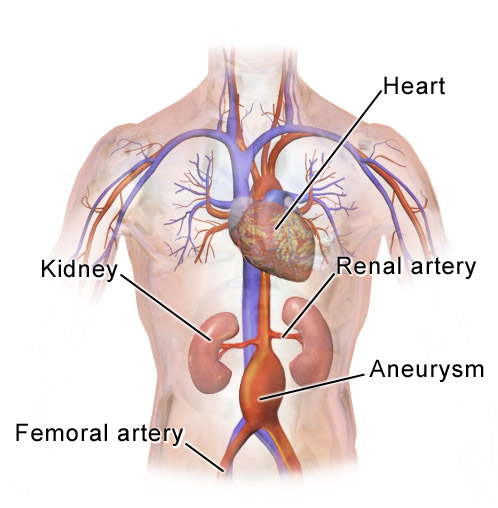
© By BruceBlaus [CC VY-SA 4.0 (https://creativecommons.org/licenses/by-sa/4.0)], via Wikimedia Commons
Abdominal aortic aneurysm causes
Causes courantes
A triple-A occurs because of a weakening in the wall of the aorta. We don't know exactly what causes this weakening to happen. Things that increase the risk of a triple-A developing include:
Age. Triple-As are rare in people under the age of 60. It's likely that ageing is involved in the development of triple-As.
Tabagisme. Smoking greatly increases the risk of developing a triple-A. It's thought that chemicals in cigarette smoke cause proteins in the aortic wall to break down, making it weaker.
Arrêter de fumer reduces the risk of developing a triple A, and also slows down the rate at which they grow.
Gender. Triple-As are six times more common in men than in women.
Genetics. People who have a close family member (parent, sibling, or child) with a triple-A have a much higher risk of developing one themselves.
Avoir diabète.
A process called atherosclerosis is thought to be important in triple-As. Atherosclerosis is when deposits of cholesterol, fat, calcium, and other chemicals build up in the wall of an artery, forming something called a plaque or atheroma. Sometimes, when this happens in the aorta, it seems to cause other processes to happen that eventually lead to weakening and swelling (aneurysm) of the aorta.
Atherosclerosis can affect arteries all throughout the body. When it affects the arteries supplying the heart, it can cause angine de poitrine et crises cardiaques; if it affects the arteries supplying the brain, it can cause les AVC; and if it affects the arteries supplying the leg muscles, it can cause peripheral vascular disease.
So, many of the risk factors for triple-As are risk factors for atherosclerosis, and for une maladie cardiaque, les AVC, and peripheral vascular disease. This also means that people with triple-As are likely to have atherosclerosis affecting other arteries, and are at a higher risk of developing heart disease and strokes (see below).
Causes plus rares
Rare causes of triple-As include:
Genetic connective tissue disorders that affect the structure of blood vessels, such as Marfan's syndrome and classical syndrome d'Ehlers-Danlos.
These tend to cause aneurysms in other parts of the aorta, such as in the chest, but can cause triple-As as well.
People with these conditions might develop a triple-A at an unusually young age.
Infections, such as:
How common are abdominal aortic aneurysms?
About 1 in 170 men over the age of 65 have an abdominal aortic aneurysm. The prevalence in women is much lower - about 1 in 600 - but the chance of rupture is significantly higher. It becomes more common with increasing age. However, most people with an abdominal aortic aneurysm are not aware that they have one (see below in the section on symptoms). A triple-A is rare in people under the age of 50.
Abdominal aortic aneurysm symptoms
Usually there are no symptoms and the person is entirely unaware they have an abdominal aortic aneurysm. At the time of diagnosis, 7 in 10 people with an abdominal aortic aneurysm will not have had any symptoms due to the aneurysm. The ballooning of the aneurysm does not cause any symptoms unless it becomes large enough to put pressure on nearby structures.
If symptoms do occur, they are likely to be:
Mild tummy (abdominal) or back pains.
There are many causes of mild abdominal and back pain. So, it may be difficult to diagnose at this stage, unless the aneurysm is large enough to be felt by a doctor when they examine the abdomen.
Sometimes, small blood clots form on the inside lining of an abdominal aortic aneurysm. These may break off and be carried down the aorta and block a smaller blood vessel further on. These blood clots are called emboli and can be dangerous. The symptoms vary depending on where the blood clot is, but might include:
Sudden, severe pain in one leg or foot.
Pale colour of the leg or foot.
Inability to move the leg or foot.
If the blood supply is completely blocked and not treated in time, affected parts of the leg or foot may die (gangrene).
The main complication from an abdominal aortic aneurysm is rupture (bursting). Symptoms of a burst aortic aneurysm include:
Sudden severe abdominal (tummy) and/or back pain.
Other symptoms caused by internal bleeding and dropping blood pressure, such as a collapse, perte de conscience, or otherwise becoming extremely unwell.
A burst aortic aneurysm is a life-threatening emergency. Call 999 for emergency medical help if you, or someone you know, has symptoms of a burst aortic aneurysm.
How is an abdominal aortic aneurysm diagnosed?
Abdominal aortic aneurysms can sometimes be felt when examining the abdomen (tummy). However, this isn't very reliable, as many of them are too small to feel.
Triple-As are usually diagnosed with:
Les échographies. These use high-frequency sound waves (ultrasound) to measure the size of the aorta, and can quickly detect a triple-A. Ultrasound scans are the basis of the triple-A screening programme in the UK (see below).
Des Scan CT. This gives more information about the exact location and size of a triple-A, and also shows if other arteries coming off the aorta are affected. This is very important information for surgeons if they are planning an operation.
Because many people with triple-As have no symptoms, they are often diagnosed when someone has an ultrasound or CT scan for another reason.
Abdominal aortic aneurysm treatments
The only definitive treatment for the aneurysm itself is surgery.
Should everyone with an abdominal aortic aneurysm have surgery?
No. For many people with a triple-A, the risk of surgery outweighs the risk of the aneurysm bursting. Surgical repair of an abdominal aortic aneurysm is a major operation and carries risks. A small number of people will die during, or shortly after, the operation.
For small abdominal aortic aneurysms, the risk of death caused by surgery is higher than the risk of bursting. Therefore, surgery is usually not advised if you have a triple-A less than 5.5 cm wide. However, regular ultrasound scans are usually offered to monitor its size over time; if it becomes large enough, surgery may be offered.
Surgery is often recommended for people with an abdominal aortic aneurysm larger than 5.5 cm, or a smaller abdominal aortic aneurysm that is growing rapidly. For these larger aneurysms the risk of rupture is usually higher than the risk of surgery. However, if your general state of health is poor, or if you have certain other medical conditions, this may increase the risk if you have surgery. So, in some cases the decision to operate may be a difficult one.
Any decision about whether to have surgery should be made between you and the surgeon, who should provide information about the risks and benefits of an operation, and how it compares to the alternative of not having surgery.
If an abdominal aortic aneurysm ruptures, it is always fatal without emergency surgery. Emergency surgery can be life-saving. However, a ruptured aortic aneurysm is still very difficult to treat; many people do not survive long enough to reach the operating theatre, and, of those that do, about half of them die despite surgery.
What operations are performed?
There are two types of surgical operation to repair an abdominal aortic aneurysm:
Open repair, or 'traditional repair' The traditional operation is to cut out the bad piece of aorta and replace it with an artificial piece of artery (a graft). It's called an 'open' repair because it involves making an incision (cut) in the abdomen (tummy) to access the aorta and other organs. This is a major operation and, as mentioned, carries some risk. Some people die during this operation. It usually requires a month or two to recover. However, it is successful in most cases and the aneurysm is totally fixed. If the operation is successful, the long-term outlook is good. The graft usually works well for the rest of your life.
Endovascular repair (EVAR)
Endovascular repair (EVAR) is an alternative to open surgery. Instead of making a cut in the abdomen, a tube-shaped graft is passed up from inside one of the leg arteries into the area of the aneurysm. This graft is then passed across the widened aneurysm and fixed to the good aorta wall, using metal clips. EVAR is now more-commonly performed than open repair.
The advantage to this type of repair is that there is no tummy (abdominal) surgery. Recovery time is usually much shorter than with open surgery. There is also a lower chance of serious complications at the time of the operation. EVAR has been particularly useful for people with other medical conditions that mean an open repair would be too risky.
However, there is a higher chance of needing another operation later on, compared to an open repair; it's roughly twice as likely with EVAR. In addition, some types of abdominal aortic aneurysms are not suitable for treatment with EVAR; for example, aneurysms that affect the arteries going to the kidneys. Some centres offer 'complex EVAR' procedures for these, though, and this area might change in future.
Choosing between open repair and EVAR depends on lots of factors. Your surgeon should discuss the benefits and risks of all the options with you, to help you come to a shared decision.
Autres traitements
People with an abdominal aortic aneurysm are likely to have atherosclerosis in other arteries, such as the heart (coronary) arteries and brain arteries. So, people with a triple-A are often at higher risk of heart disease and strokes.
In fact, most people who develop an abdominal aortic aneurysm do not die of the aneurysm but die from other vascular conditions, such as a heart attack or stroke.
Therefore, it's very important to reduce the risk of these happening. Ways to do this include:
Mangez un régime sain which includes keeping a low salt intake.
Exercice as much as you are able.
If you have high blood pressure, diabetes or a high cholesterol level, they should be well controlled on treatment.
You may be prescribed a statin drug to lower your cholesterol level et low-dose aspirin to help to prevent blood clots from forming.
Voir la brochure séparée intitulée Maladie cardiovasculaire (Athérome) pour plus de détails.
Dépistage de l'anévrisme de l'aorte abdominale
In the UK, there is a national screening programme to detect abdominal aortic aneurysms in men. This is because many people with triple-As have no symptoms, and would otherwise go undiagnosed; research evidence shows that diagnosis and treatment can help to prevent complications from triple-As in future.
In England, Wales, Scotland, and Northern Ireland, men aged 65 are invited for a one-off ultrasound scan to check for an abdominal aortic aneurysm.
If an aneurysm is found, men may be offered surgery or observation, depending on the size of the aneurysm.
Screening for triple-As is currently only offered to men, as they are much more common in men than in women.
What is the chance of an abdominal aortic aneurysm rupturing?
The chance of bursting (rupture) is low if a triple-A is small. As a rule, the risk of rupture increases with increasing size. This is much like a balloon - the larger you blow it up, the greater the pressure and the greater the chance it will burst.
The diameter of a triple-A can be measured by an ultrasound scan. As a rule, for any given size, the risk of rupture is increased in smokers, women, those with high blood pressure and those with a family history of AAA.
Sélections des patients pour Blood vessel disorders

Santé cardiaque et vaisseaux sanguins
Dissection aortique
An aortic dissection is a rare, serious condition. The inner layer of the aorta (the biggest blood vessel in the body, coming directly from the heart) tears. Blood then surges through the tear. This causes the inner and middle layers of the aorta to separate (dissect). Aortic dissection is a medical emergency and needs urgent treatment. The treatment for aortic dissection includes an operation to repair the wall of the aorta. Medicines to reduce blood pressure are also used. Aortic dissection is often fatal but early diagnosis and treatment of aortic dissection can greatly improve survival.
par Dr Colin Tidy, MRCGP

Santé cardiaque et vaisseaux sanguins
Syndrome d'Osler-Weber-Rendu
Le syndrome d'Osler-Weber-Rendu est un trouble des vaisseaux sanguins qui peut provoquer des saignements excessifs. Le syndrome d'Osler-Weber-Rendu est également appelé télangiectasie hémorragique héréditaire. Les vaisseaux sanguins anormaux peuvent provoquer des saignements à la fois dans la peau et à l'intérieur de votre corps.
par Dr Colin Tidy, MRCGP
Questions fréquemment posées
À quelle fréquence le suivi est-il nécessaire pour les petits anévrismes de l'aorte abdominale ?
Si vous avez un petit anévrisme de l'aorte abdominale (moins de 5,5 cm), des échographies régulières sont proposées pour surveiller sa taille au fil du temps. La fréquence de ces examens sera déterminée par votre médecin, mais l'objectif est de suivre toute modification afin que la chirurgie puisse être envisagée si l'anévrisme devient suffisamment grand pour le justifier.
Qu'est-ce que l'athérosclérose et quel est son lien avec les anévrismes de l'aorte abdominale ?
L'athérosclérose est un processus où des dépôts de cholestérol, de graisse, de calcium et d'autres substances chimiques s'accumulent dans les parois des artères, formant des plaques. Lorsque cela se produit dans l'aorte, on pense que cela contribue à l'affaiblissement et au gonflement qui conduisent à un anévrisme de l'aorte abdominale. De nombreux facteurs de risque pour les triples-A sont également des facteurs de risque pour l'athérosclérose, qui peut affecter les artères dans tout le corps, conduisant potentiellement à des conditions comme les maladies cardiaques ou les AVC.
Existe-t-il des situations spécifiques où l'EVAR (réparation endovasculaire) pourrait ne pas être approprié ?
Oui, certains types d'anévrismes de l'aorte abdominale ne conviennent pas au traitement par EVAR. Par exemple, les anévrismes qui affectent les artères allant aux reins peuvent rendre cette procédure plus difficile ou inappropriée. Dans certains centres spécialisés, des procédures 'EVAR complexes' peuvent être proposées pour ces cas, et ce domaine de traitement pourrait évoluer à l'avenir.
Qu'est-ce qui augmente spécifiquement le risque de rupture pour une taille d'anévrisme donnée ?
Même pour un anévrisme de l'aorte abdominale d'une taille spécifique, certains facteurs peuvent augmenter le risque de rupture. Ceux-ci incluent le tabagisme, être une femme, avoir une pression artérielle élevée et des antécédents familiaux d'anévrismes de l'aorte abdominale.
Pourquoi le dépistage des anévrismes de l'aorte abdominale est-il uniquement proposé aux hommes au Royaume-Uni ?
Au Royaume-Uni, le dépistage des anévrismes de l'aorte abdominale est actuellement proposé uniquement aux hommes car ces anévrismes sont significativement plus fréquents chez les hommes que chez les femmes. La recherche a montré que diagnostiquer et traiter ces anévrismes chez les hommes peut aider à prévenir des complications futures.
Lectures complémentaires et références
- Cosford PA, Leng GC; Screening for abdominal aortic aneurysm. Cochrane Database Syst Rev. 2007 Apr 18;(2):CD002945.
- Badger S, Bedenis R, Blair PH, et al; Endovascular treatment for ruptured abdominal aortic aneurysm. Cochrane Database Syst Rev. 2014 Jul 21;7:CD005261. doi: 10.1002/14651858.CD005261.pub3.
- Lignes directrices sur le diagnostic et le traitement des maladies aortiques; Société Européenne de Cardiologie (2014)
- Anévrisme de l'aorte abdominale : diagnostic et prise en charge; Recommandations NICE (mars 2020)
À propos de l'auteurVoir la biographie complète

Dr Doug McKechnie, MRCGP
Rédacteur Médical
MA, MBBS, MSc, DRCOG, MRCP(UK), MRCGP(2021), FHEA
Le Dr Doug McKechnie est un médecin généraliste du NHS travaillant à Londres. Il travaille à plein temps en clinique et est également le chef adjoint du module de Pratique Clinique et Professionnelle à l'École de Médecine de l'University College London.
À propos du critiqueVoir la biographie complète

Dr Colin Tidy, MRCGP
Médecin généraliste, Auteur médical
MBBS, MRCGP, MRCP (Paediatrics), DCH
Le Dr Colin Tidy est un médecin du NHS, basé dans l'Oxfordshire.
Historique de l'article
Les informations sur cette page sont rédigées et examinées par des cliniciens qualifiés.
Article également disponible en Anglais, Allemand, Espagnol, Français, Italien, Portugais, Hindi, Hébreu, Arabe, and Suédois.
Prochaine révision prévue : 17 sept. 2028
19 sept. 2023 | Dernière version

Demandez, partagez, connectez-vous.
Parcourez les discussions, posez des questions et partagez vos expériences sur des centaines de sujets de santé.

Vous ne vous sentez pas bien ?
Évaluez vos symptômes en ligne gratuitement
Inscrivez-vous à la newsletter Patient
Votre dose hebdomadaire de conseils de santé clairs et fiables - rédigés pour vous aider à vous sentir informé, confiant et maître de la situation.
En vous abonnant, vous acceptez notre Politique de confidentialité. Vous pouvez vous désabonner à tout moment. Nous ne vendons jamais vos données.
Plus sur la santé cardiaque et les vaisseaux sanguins
- Syndrome coronarien aigu
- Alpha-bloquants
- Angine de poitrine
- Régurgitation aortique
- Sténose aortique
- Artérite à cellules géantes
- Granulomatose avec polyangéite
- Récupération après une crise cardiaque
- Maladies cardiaques
- Hypertension artérielle pendant la grossesse
- Hypercholestérolémie
- Diurétiques de l'anse
- Hypotension
- Médicament à base de nitrates
- Péricardite
- Maladie artérielle périphérique
- Œdème pulmonaire
- Diurétiques thiazidiques
- Ulcères veineux de la jambe
- Communication interventriculaire