Dissection aortique
Revu par des pairs par Dr Hayley Willacy, FRCGP Dernière mise à jour par Dr Colin Tidy, MRCGPDernière mise à jour 13 nov. 2024
Respecte les directives éditoriales
- TéléchargerTélécharger
- Partager
- Language
- Discussion
- Version audio
- Ajouter aux sources préférées sur Google
Dans cette série :Anévrisme de l'aorte abdominaleSyndrome de Marfan
An aortic dissection is a rare, serious condition. The inner layer of the aorta (the biggest blood vessel in the body, coming directly from the heart) tears. Blood then surges through the tear. This causes the inner and middle layers of the aorta to separate (dissect).
Aortic dissection is a medical emergency and needs urgent treatment. The treatment for aortic dissection includes an operation to repair the wall of the aorta. Medicines to reduce blood pressure are also used. Aortic dissection is often fatal but early diagnosis and treatment of aortic dissection can greatly improve survival.
En un coup d'œil
An aortic dissection occurs when the inner layer of the aorta, the body's largest blood vessel, tears.
Blood surges through the tear, causing the inner and middle layers of the aorta to separate.
Symptoms include sudden, severe chest pain, often described as tearing, ripping, or shearing.
The pain may spread to the neck or back and can be accompanied by shortness of breath or loss of consciousness.
High blood pressure and certain medical conditions can increase the risk of aortic dissection.
Aortic dissection is a medical emergency requiring immediate treatment, often surgery.
Early diagnosis and treatment significantly improve the chance of survival.
What is the aorta?
The aorta is the largest blood vessel in the body. It is an artery and carries blood from the heart and descends through the chest and the tummy (abdominal aorta).
The part of the aorta that connects with the heart is called the aortic root. The aorta then goes up towards the head (ascending aorta) but then loops (aortic arch) and heads down towards the abdomen (descending aorta).
Many arteries come off the aorta to supply blood to all parts of the body. At about the level of the hips, the aorta divides into two arteries, one going to each leg.
The aorta
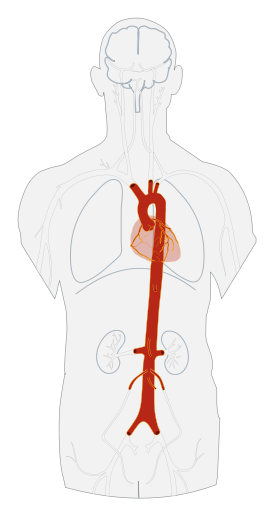
© By Edorado (Own work based on: Arterial System en.svg, Coronary arteries.svg) via Wikimedia Commons
Qu'est-ce qu'une dissection aortique ?
An aortic dissection occurs in a weakened area of the wall of the aorta. An aortic dissection is a serious condition of sudden onset in which the inner layer of the aorta tears. Blood then surges through the tear, causing the inner and middle layers of the aorta to separate (dissect).
Aortic wall layers
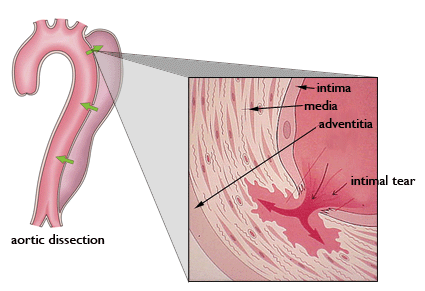
© Image: patient information from the International Registry of Acute Aortic Dissection
Aortic dissections are divided into two groups, depending on which part of the aorta is affected:
Type A aortic dissection
Type A. This involves a tear in the part of the aorta where it exits the heart or a tear in the upper aorta (ascending aorta). The tear may extend into the descending aorta and may extend into the tummy (abdomen).
Type B aortic dissection
Type B. This involves a tear in the lower aorta only (descending aorta). The tear may also extend into the abdomen but any tear that involves the ascending aorta is called a type A aortic dissection.
Aortic dissection symptoms
Aortic dissection may cause:
Sévère douleur thoracique.
Essoufflement.
The symptoms may be very similar to those of a heart attack.
The chest pain starts suddenly and is often described as a tearing, ripping or shearing feeling.
The pain often spreads to the neck or down the back.
Aortic dissection may also cause loss of consciousness or symptoms similar to a stroke.
There will often be changes in blood pressure and heart rate, with an increased heart rate and low blood pressure.
These may be, for example:
Loss of vision.
Weakness of your legs.
Weakness of one side of your body.
What causes aortic dissection?
Certain conditions make a tear in the wall of the aorta more likely.
Hypertension artérielle over a long period of time may weaken the wall of the aorta, making it more likely to tear.
People who already have an enlarged aorta (anévrisme aortique) are also at increased risk of aortic dissection.
Some people are born with a condition that causes a weakened wall of the aorta, such as connective tissue disorders. These conditions are uncommon and include Syndrome de Marfan, bicuspid aortic valve and syndrome d'Ehlers-Danlos.
There is an increased risk of aortic dissection with regular cocaine or amphetamine use and with any extremely strenuous exercise such as weightlifting.
A severe injury to the chest may also cause aortic dissection.
Sténose aortique, previous cardiac surgery, having a history of aortic diseases in your family and smoking can also increase the risk.
How is aortic dissection diagnosed?
Initial investigations to diagnose aortic dissection and rule out a heart attack may include:
Analyses de sang.
A chest X-ray.
An ultrasound scan of your heart (echocardiogram, or echo). Either transthoracic or transoesophageal echocardiography may be used.
A computed tomography (CT) scan ou un examen d'imagerie par résonance magnétique (IRM).
What is the treatment for aortic dissection?
An aortic dissection is an emergency and needs immediate treatment. Immediate treatment often involves surgery to repair the damaged aorta.
However, medicines such as beta blockers and nitroprusside may be used before surgery to reduce your heart rate and lower your blood pressure. Using these medicines can help to prevent the aortic dissection from becoming worse and so make surgery more likely to be successful. Surgery for type A aortic dissection may also include replacing the aortic valve of the heart at the same time if this is affected.
After the initial treatment, you may need to take medicine to lower your blood pressure. It is likely that you will remain on this medicine to control your blood pressure for the rest of your life. You may also need regular checks with a specialist doctor, including CT or MRI scans, to monitor the aorta in case any further problems occur.
What are the complications of aortic dissection?
An aortic dissection may cause death due to severe internal bleeding.
Death may also occur as a result of damage to an organ (for example, lésion rénale aiguë), or as a result of a AVC or damage to the aortic valve of your heart.
Blood may also rupture into the lining around your heart (pericardium) to cause severe pressure on your heart (this is called cardiac tamponade).
Questions Fréquemment Posées
How common is aortic dissection?
Aortic dissection is relatively uncommon. The condition most frequently occurs in people in their 50s and 60s and is rare in people under 40 years of age. Aortic dissection is more common in men but is still very rare: only about 30 people per million will have one, in a year.
Quel est le pronostic ?
Aortic dissection is often fatal if the blood-filled channel within the wall of the aorta ruptures through to the outside aortic wall (this is called aortic rupture). However, early diagnosis and treatment of aortic dissection can greatly improve survival.
Can aortic dissection be prevented?
The most effective ways to prevent aortic dissection are to take regular medicine to control blood pressure if you are found to have high blood pressure. You can also reduce your risk by reducing the risk of damage to your heart and arteries. This can be achieved by eating a healthy diet, taking regular exercise, keeping to an ideal body weight and avoiding smoking.
Sélections des patients pour Blood vessel disorders

Santé cardiaque et vaisseaux sanguins
Spasme de l'artère coronaire
Le spasme de l'artère coronaire est un rétrécissement temporaire et soudain d'une ou plusieurs artères coronaires.
par Dr Hayley Willacy, FRCGP

Santé cardiaque et vaisseaux sanguins
Maladie artérielle périphérique
La maladie artérielle périphérique, également appelée maladie vasculaire périphérique, est un rétrécissement des vaisseaux sanguins (artères). En plus d'être connue sous le nom de maladie vasculaire périphérique (MVP), elle est parfois aussi appelée 'durcissement' des artères des jambes.
par Dr Hayley Willacy, FRCGP
Questions fréquemment posées
What specifically is the internal process of the tear and separation within the aorta?
An aortic dissection begins when the inner layer of the aorta tears. Once this tear occurs, blood surges through it, causing the inner and middle layers of the aorta to separate or "dissect" from each other. This creates a new channel for blood flow within the wall of the aorta itself, rather than flowing purely through the main lumen.
Lectures complémentaires et références
- Anévrisme de l'aorte abdominale : diagnostic et prise en charge; Recommandations NICE (mars 2020)
- Sayed A, Munir M, Bahbah EI; Dissection aortique : Une revue de la physiopathologie, de la gestion et des avancées prospectives. Curr Cardiol Rev. 2021;17(4):e230421186875. doi: 10.2174/1573403X16666201014142930.
- Gawinecka J, Schonrath F, von Eckardstein A; Dissection aortique aiguë : pathogénie, facteurs de risque et diagnostic. Swiss Med Wkly. 25 août 2017;147:w14489. doi: 10.4414/smw.2017.14489. eCollection 2017.
- Zhou Z, Cecchi AC, Prakash SK, et al; Facteurs de risque de dissection aortique thoracique. Genes (Bâle). 2022 Oct 7;13(10):1814. doi: 10.3390/genes13101814.
- Abraha I, Romagnoli C, Montedori A, et al; Greffe de stent thoracique versus chirurgie pour anévrisme thoracique. Cochrane Database Syst Rev. 2016 6 juin;(6):CD006796. doi: 10.1002/14651858.CD006796.pub4.
À propos de l'auteurVoir la biographie complète

Dr Colin Tidy, MRCGP
Médecin généraliste, Auteur médical
MBBS, MRCGP, MRCP (Paediatrics), DCH
Le Dr Colin Tidy est un médecin du NHS, basé dans l'Oxfordshire.
À propos du critiqueVoir la biographie complète

Dr Hayley Willacy, FRCGP
Médecin généraliste, Auteur médical
MBChB (1992), DRCOG, DFFP, MRCOG (Part 1) MRCGP (2007), DFSRH (2013), MSc - medical education (2020)
Le Dr Hayley Willacy était médecin généraliste au NHS travaillant dans le nord-ouest de l'Angleterre, qui a pris sa retraite de la pratique clinique en 2022 après 30 ans.
Historique de l'article
Les informations sur cette page sont rédigées et examinées par des cliniciens qualifiés.
Article également disponible en Anglais, Allemand, Espagnol, Français, Italien, Portugais, Hindi, Hébreu, Arabe, and Suédois.
Next review due: 12 Nov 2027
13 nov. 2024 | Dernière version

Demandez, partagez, connectez-vous.
Parcourez les discussions, posez des questions et partagez vos expériences sur des centaines de sujets de santé.

Vous ne vous sentez pas bien ?
Évaluez vos symptômes en ligne gratuitement
Inscrivez-vous à la newsletter Patient
Votre dose hebdomadaire de conseils de santé clairs et fiables - rédigés pour vous aider à vous sentir informé, confiant et maître de la situation.
En vous abonnant, vous acceptez notre Politique de confidentialité. Vous pouvez vous désabonner à tout moment. Nous ne vendons jamais vos données.
Plus sur la santé cardiaque et les vaisseaux sanguins
- Anévrisme de l'aorte abdominale
- Syndrome coronarien aigu
- Alpha-bloquants
- Bêta-bloquants
- Bloqueurs des canaux calciques
- Évaluation du risque pour la santé cardiovasculaire
- Diabète et hypertension artérielle
- Cardiomyopathie dilatée
- Électrocardiogramme
- Test d'effort
- Hypercholestérolémie familiale
- Récupération après une crise cardiaque
- Maladie des valves cardiaques
- Enregistrement de la pression artérielle à domicile et ambulatoire
- Myocardite
- Maladie artérielle périphérique
- Syndrome de tachycardie posturale
- Diurétiques épargneurs de potassium
- Tachycardie supraventriculaire
- Accident ischémique transitoire