Douleur dans le quadrant inférieur gauche
Lower left abdominal pain
Revu par Dr Toni Hazell, FRCGPDernière mise à jour par Dr Philippa Vincent, MRCGPDernière mise à jour 30 mars 2026
Respecte les directives éditoriales
- TéléchargerTélécharger
- Partager
- Language
- Discussion
- Version audio
- Ajouter aux sources préférées sur Google
Dans cette série :Douleur dans le quadrant inférieur gauche pendant la grossesseDouleur abdominale du côté gauche chez les enfants
La douleur du quadrant inférieur gauche (QIG) est une douleur abdominale principalement située dans la moitié inférieure du côté gauche. Il existe de nombreuses causes de douleur du QIG.
Points clés
La douleur du quadrant inférieur gauche (QIG) est une douleur sur le côté gauche de votre abdomen (ventre), en dessous de votre nombril.
Common causes include constipation, gastroenteritis, IBS, diverticulitis, and endometriosis. However, there are many other causes.
The treatment for LLQ pain depends on the cause but may include dietary changes, pain relief, and in severe cases surgery.
Where is my left lower quadrant?
Look down at your abdomen and mentally divide the area from the bottom of your ribs down to your pubic hair into four quarters. The quarter on your left side below your belly button is your left lower quadrant (LLQ).
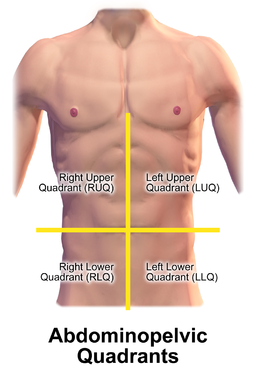
© By Blausen.com staff (2014). “Medical gallery of Blausen Medical 2014”. WikiJournal of Medicine 1 (2). DOI:10.15347/wjm/2014.010. ISSN 2002-4436
What organs are in my left lower quadrant?
The left lower quadrant contains organs including:
Small bowel (ileum).
Parts of the large bowel (colon).
Rectum.
Left ureter.
Left ovary and Fallopian tube in women.
La peau, les nerfs et les vaisseaux sanguins de cette zone.
Causes of left lower quadrant pain
There are lots of causes of LLQ pain; they include:
Constipation.
Gastroenteritis and food poisoning.
Irritable bowel syndrome (IBS).
Diverticulitis.
Colon and rectal cancer.
Endometriosis.
Pelvic inflammatory disease.
Torsion of the testicle.
Constipation
Constipation can cause discomfort anywhere in your abdomen.
Elle est causée par l'accumulation de selles dans le côlon ; l'inconfort ou la douleur est dû au fait que le côlon est étiré.
You will often (but not always) be aware that you are not opening your bowels as often as usual.
Your poo will often be hard and pellet-like; sometimes it is painful to pass.
Parfois (et principalement chez les enfants ou les personnes âgées), il y aura des selles molles (diarrhée) parce que la constipation est plus haut et cause un blocage ; les selles deviennent liquides et s'infiltrent autour du bord du blocage. Cela s'appelle "diarrhée par débordement".
Gastroenteritis and food poisoning
Gastro-entérite, which is usually caused by a virus, is an infection which can cause pain anywhere in your abdomen.
It can also cause diarrhoea, make you feel sick (nausea) or be sick (vomit).
La douleur ressemble souvent à des crampes et peut s'atténuer un moment chaque fois qu'une diarrhée est évacuée.
L'intoxication alimentaire peut être causée par un virus ou une bactérie, et présente des symptômes similaires à ceux de la gastro-entérite. Si vous pensez avoir une intoxication alimentaire, un test de selles peut être effectué après 7 jours de symptômes pour rechercher des bactéries spécifiques.
Syndrome de l'intestin irritable (SII)
Syndrome de l'intestin irritable (SII) tends to cause crampy abdominal pains and bloating.
It comes and goes and may be associated with diarrhoea and/or constipation.
Diverticulite
Diverticulite in the last part of the large gut (sigmoid colon) is the most common cause of left lower quadrant (LLQ) pain in adults.
It usually comes with a temperature (fever) and a change in bowel habit (opening your bowels more or less often than usual for you).
Colon cancer and rectal cancer
Severe LLQ pain, bloating and not being able to open your bowels at all, même pas pour évacuer des gaz (flatus), sont des symptômes qui suggèrent que vous pourriez avoir une obstruction dans votre intestin. L'obstruction complète de l'intestin est une urgence médicale - vous devez vous rendre aux urgences.
Colon cancer and rectal cancer (sometimes called colorectal cancer) are two of the more common cancers in the UK and can cause left lower quadrant (LLQ) pain.
Although colon cancer can affect any part of the large bowel (colon), it commonly affects the last part (descending colon and sigmoid colon) which is on the left-hand side. Rectal cancer affects the very last part of the large bowel (rectum) just before it ends at the anus.
Vous pourriez remarquer des changements dans la fréquence de vos selles, une sensation de ne pas vider complètement votre rectum, une perte de poids inexpliquée ou une baisse d'énergie, et la présence de sang dans vos selles.
Trapped inguinal or femoral hernia
Des left inguinal or femoral hernia does not usually cause much pain but, if it becomes strangulated, it can cause pain in the groin and in the abdomen, usually on the side of the hernia but it may cause pain over the whole abdomen.
If it happens on the left-hand side, there will be a tender swelling in the left groin.
They occur when a piece of bowel or other tissue from inside the abdomen pushes through a weakness in the muscles of the abdominal wall near the left groin (where the left thigh meets your lower abdomen).
Left lower quadrant pain causes in women
Ovulation pain (mittelschmerz)
Ovulation is the point at which your ovary releases an egg - this is usually about halfway between two periods.
Mittelschmerz or ovulation pain is when women experience pain when this happens.
Between 1 and 2 in 5 women experience ovulation pain.
It can be severe and last a few minutes or more of a dull pain which lasts a few hours.
It will only be felt on one side, but can be right or left.
You may get similar pain on the same or other side of your abdomen at the same point in another cycle.
Maladie inflammatoire pelvienne
Maladie inflammatoire pelvienne causes pain that is usually on both sides of the abdomen but can be in the (left lower quadrant) LLQ.
Pain is often worse during sex because the cervix (neck of the womb) is very tender.
You may also have abnormal bleeding, feel generally unwell and feverish, and have smelly vaginal discharge.
Twisted ovary
Twisted ovary (ovarian torsion) usually only occurs if a fluid-filled sac (cyst) has developed on the ovary.
Pain can be constant or intermittent.
Endométriose
Endométriose can sometimes cause constant lower abdominal pain, although usually it is worse just before, during and for a short while after a period.
Pain is usually across the lower part of the abdomen but it can be just on the left side.
Grossesse extra-utérine
Si vous êtes enceinte et ressentez une douleur intense dans votre quadrant inférieur gauche (ou quadrant inférieur droit), cela pourrait être une grossesse extra-utérine. C'est une urgence médicale et vous devez vous rendre aux urgences immédiatement .
Grossesse extra-utérine is a pregnancy that is developing in the Fallopian tube instead of in your womb.
It can cause left lower quadrant pain that is sudden or gradually worsening, and may become severe.
Vaginal bleeding is common but may differ from a normal period (lighter/heavier, darker, or mistaken for a late period). Not everyone who has an ectopic pregnancy has bleeding.
Les symptômes associés peuvent inclure la diarrhée, des douleurs lors de la défécation, des étourdissements, des évanouissements ou un malaise général
Shoulder-tip pain may occur due to internal bleeding irritating the diaphragm.
Cancer de l'ovaire
Parfois cancer de l'ovaire presents with pain or a feeling of pressure in the lower half of the abdomen. This can be on one side or across the whole area.
Women with ovarian cancer may notice bloating.
Left lower quadrant pain causes in men
Any pain coming from the left side of the scrotum can cause pain in the left lower quadrant (LLQ) but usually the pain in the scrotum will be worse than the pain in the abdomen.
Torsion of the testicle
Torsion of the testicle (testis) is where the testicle twists and the blood supply is cut off.
Elle provoque une douleur intense dans le scrotum et une douleur intense dans le quadrant inférieur, généralement d'un côté.
The testicle is very tender.
C'est une urgence médicale et vous devez vous rendre immédiatement au service des urgences le plus proche.
Épididymo-orchite
Épididymo-orchite is an inflammation of the testicle and/or the tubes surrounding it (epididymis).
The affected side of the scrotum can swell and become red and tender.
Sometimes epididymo-orchitis causes less severe pain but is usually tender on examination.
Other possible causes of left lower quadrant pain
Inflammatory bowel disease (IBD): IBD (maladie de Crohn et la colite ulcéreuse) cause the lining of the gut to become inflamed, and this can cause pain in the left lower quadrant (LLQ).
Volvulus sigmoïde: This happens when the very last part of the large bowel, the sigmoid, twists on itself causing a blockage. This causes colicky pain and a severely bloated abdomen. It is dangerous and requires emergency surgery.
Calculs rénaux: Une pierre qui passe dans l'uretère drainant l'urine de votre rein droit peut provoquer une douleur qui commence dans votre flanc droit et se propage à votre aine et au quadrant inférieur gauche (QIG), ou dans votre testicule si vous êtes un homme.
Zona: A sharp or burning pain may be felt in the abdomen before a rash develops.
Anévrisme de l'aorte abdominale: This can cause pain before it bursts. The pain is usually felt in your back or the middle of your abdomen but it can occasionally be felt in the left (or right) lower quadrant.
Referred pain: Pain from your back or hip may be felt around the front into the left (or right) lower quadrant.
Muscle sprains: This can cause pain in your abdomen when you use the pulled or strained muscle to move, cough or laugh.
Quand consulter un médecin
If you have a pain which doesn't settle, you will probably need to consult a health professional to help you figure out the cause.
Consult a doctor urgently if you:
Have very severe pain.
Have persistent sickness (vomiting).
Have recently lost weight without trying to do so.
Feel giddy, light-headed, faint or breathless.
Remarquez du sang dans vos selles ou sur le papier toilette.
Have a change from your usual bowel habit. This means you may open your bowels more or less often than usual, causing bouts of diarrhoea or constipation.
Notice bloating which is getting worse.
Vous devriez vous rendre d'urgence aux urgences si vous :
Could be pregnant (you should do a pregnancy test from a pharmacy first).
Have severe pain in your scrotum which started suddenly or over a short period of time.
How is left lower quadrant pain diagnosed?
Your doctor will usually be able to diagnose the cause of your left lower quadrant (LLQ) pain by talking to you to find out about the pain, and examining you.
They will examine your abdomen, including in the area you have the pain. They may sometimes need to examine your bottom (this does not happen in children except by specialists in very rare situations). You may also be asked to provide a échantillon d'urine (pipi), to rule out infection.
Women may need an internal examination to rule out or diagnose problems such as pelvic inflammatory disease. Men may need an examination of their scrotum and testicles.
You should always be offered a chaperone for an intimate examination.
Swabs might be taken from women to look for infections such as chlamydia - in men, these are usually tested for by a urine sample.
You may also need blood tests to:
Check the function of your liver and reins.
Rule out any inflammation or infection in your body.
Look for l'anémie.
Check your blood sugar level.
Tests supplémentaires
If your doctor is still unsure of the cause of pain, they may recommend further tests such as:
Further blood tests, for example for maladie cœliaque.
Tests de selles pour détecter du sang ou une inflammation.
Échographie - this is particularly used to look at your ovaries and womb if you are a woman, testicles if you are a man, and the bladder and kidneys.
Tomodensitométrie (scanner) - this is used to look for diverticula in the bowel, and also to look at your kidneys. Depending on where you live, your GP might be able to organise a CT scan for specific conditions.
Very occasionally, an radiographie may be used to look for constipation - this is mainly in young children where the diagnosis is unclear.
If the answers are still not clear, you may be referred for further tests including:
Coloscopie - this is when a small camera (a scope) is used to check your large bowel.
Sigmoïdoscopie - this is when a camera is used to check the lower part of your large bowel.
Imagerie par résonance magnétique (IRM) - this can be used to look at many of the organs in your abdomen.
Nobody will need all these tests, and some people may not need any.
Left lower quadrant pain treatment
The treatment for left lower quadrant (LLQ) pain depends on the cause. See the relevant leaflet for the condition with which you have been diagnosed. Treatments for a few of the causes of LLQ pain are briefly discussed below.
Constipation. This can be avoided by eating plenty of fruit and vegetables, as well as other foods containing fibre. If your constipation is mild, adding these things to your diet might be enough to treat the constipation. You may be prescribed medication to treat your constipation. Nowadays this is usually with a liquid.
Gastroenteritis and food poisoning. Most people do not need any treatment for this. Small children and elderly adults may become very unwell and need fluids through a drip. It is usually best to avoid medications to try and stop the diarrhoea as this usually makes the symptoms last longer. If the diarrhoea continues for 7 days, a poo test might be done. If this shows a bacteria, then antibiotics might be suggested.
Irritable bowel syndrome. Some people can manage their pain from irritable bowel syndrome by changing their diet and avoiding any "trigger foods". You may be prescribed medication which reduces the spasming of your bowel. These can also be bought over the counter.
Diverticulitis. Diverticulitis causing pain and fever often needs antibiotics to treat it. It can usually be treated with antibiotics by mouth but some people need to be admitted to hospital for antibiotics into a vein.
Colon and rectal cancer. Bowel cancer is often treated with surgery or chemotherapy or both together. The treatment depends on where in the bowel the cancer is and how advanced it is when the cancer is found.
Endometriosis. Endometriosis is usually treated with hormones - for example, the oral contraceptive pill. Some women may need different hormonal treatments or surgery; both of these would be provided by a gynaecologist.
Pelvic inflammatory disease. This is treated with antibiotics.
Ectopic pregnancy. This is usually treated with emergency surgery but some women can be treated with a tablet called methotrexate if the pregnancy is very small. A blood test to measure the level of pregnancy hormone in your blood will usually help the doctors to decide which treatment is best for you.
Torsion of the testicle. This is treated with emergency surgery to untwist the testicle. The testicle is usually then "fixed" in place so that it cannot happen again.
Quelle est la perspective ?
The outlook for left lower quadrant (LLQ) pain depends entirely on the cause of the pain. Some conditions settle very quickly on their own (for example, gastroenteritis), or with the help of antibiotics (for example, a kidney infection). Others can be cured with surgery, such as torsion of the testis.
Some are long-term conditions, such as Crohn's disease or coeliac disease. There is no cure for these conditions but there are treatments which will manage the symptoms.
Your doctor should be able to give you an idea of the outlook (prognosis) once a diagnosis has become clear.
Questions fréquemment posées
Quelles sont les causes de la douleur dans le quadrant inférieur gauche lors de la respiration ou de la toux ?
La douleur dans le quadrant inférieur gauche lors d'une respiration profonde ou en toussant est souvent due à une douleur musculaire. Si elle persiste plus de quelques jours et que vous n'êtes pas conscient d'avoir tiré un muscle, ou si elle s'aggrave plutôt que de s'améliorer, vous devriez consulter un médecin.
What causes lower left quadrant pain when walking?
La douleur dans le quadrant inférieur gauche en marchant est souvent due à une douleur musculaire. Elle peut également être causée par une douleur de la hanche "référée" dans votre abdomen. Cela signifie que, bien que la douleur provienne de votre hanche, votre cerveau pense qu'elle provient de l'abdomen. Si la douleur s'aggrave plutôt que de s'améliorer, vous devriez consulter un médecin.
Can kidney infection cause lower left quadrant pain?
Une infection rénale peut causer des douleurs n'importe où le long de votre tractus urinaire (de votre rein, en descendant votre uretère, ou dans votre vessie ou votre urètre). Cela peut donc être n'importe où depuis votre flanc (juste en dessous de vos côtes), autour du côté et jusqu'au quadrant inférieur gauche (QIG). Cependant, il serait inhabituel d'avoir des douleurs uniquement dans le QIG ; elles seraient généralement associées à des douleurs dans le flanc gauche également.
Sélections des patients pour Douleur abdominale

Santé digestive
Douleur dans le quadrant supérieur droit
La douleur du quadrant supérieur droit (QSD) est une douleur située dans la partie supérieure de l'abdomen du côté droit. Il existe de nombreuses causes de douleur au QSD.
par Dr Philippa Vincent, MRCGP
Santé digestive
Douleur abdominale
Abdominal pain means pain in the stomach. Usually it doesn't last long and is often due to a gut infection or a small upset - but there are many other possible causes. Pain that is severe or doesn't settle quickly may need attention from a doctor.
par Dr Toni Hazell, FRCGP
Lectures complémentaires et références
- Cancer suspecté : reconnaissance et orientation; Directive NICE (2015 - dernière mise à jour avril 2026)
À propos de l'auteurVoir la biographie complète

Dr Philippa Vincent, MRCGP
Médecin généraliste, Auteur médical
MB BS, Bsc, MRCGP (2000), DCH, DFSRH, DRCOG
Dr Philippa Vincent est un médecin généraliste du NHS travaillant dans le nord de Londres.
À propos du critiqueVoir la biographie complète

Dr Toni Hazell, FRCGP
MBBS, BSc, FRCGP, DFSRH, Dip GU med, DRCOG, DCH (London, UK, 2000)
Le Dr Toni Hazell a obtenu son diplôme de l'École de médecine de l'hôpital St. Mary et a effectué son VTS à l'hôpital Northwick Park.
Historique de l'article
Les informations sur cette page sont rédigées et examinées par des cliniciens qualifiés.
Article également disponible en Anglais, Allemand, Espagnol, Français, Italien, Portugais, Hindi, Hébreu, Arabe, and Suédois.
30 mars 2026 | Dernière version

Demandez, partagez, connectez-vous.
Parcourez les discussions, posez des questions et partagez vos expériences sur des centaines de sujets de santé.

Vous ne vous sentez pas bien ?
Évaluez vos symptômes en ligne gratuitement
Inscrivez-vous à la newsletter Patient
Votre dose hebdomadaire de conseils de santé clairs et fiables - rédigés pour vous aider à vous sentir informé, confiant et maître de la situation.
En vous abonnant, vous acceptez notre Politique de confidentialité. Vous pouvez vous désabonner à tout moment. Nous ne vendons jamais vos données.