Antécédents et examen génito-urinaires - homme
Revu par Dr Philippa Vincent, MRCGPDernière mise à jour par Dr Hayley Willacy, FRCGP Dernière mise à jour 27 janv. 2025
Respecte les directives éditoriales
- TéléchargerTélécharger
- Partager
- Language
- Discussion
- Version audio
- Ajouter aux sources préférées sur Google
Professionnels de la santé
Les articles de référence professionnelle sont conçus pour être utilisés par les professionnels de la santé. Ils sont rédigés par des médecins britanniques et basés sur des preuves de recherche, des directives britanniques et européennes. Vous pouvez trouver l'un de nos articles de santé plus utile.
Despite the increasingly widespread use of imaging of the urinary tract, a thorough history and examination are essential in the assessment of all patients presenting with genitourinary symptoms.
The presentation must be assessed in the context of the age, gender and past medical and surgical history of the patient. Urinary symptoms may not be indicative of urological abnormality but may have other causes such as frequency of micturition in anxiety or urinary symptoms caused by neurological disease.
The following account will both list important items as an aide-mémoire and provide diagnostic tips and suggestions for history and examination. Paediatric genitourinary history and examination are referred to and important aspects particular to developing children are outlined. The separate partner article Genitourinary history and examination -female covers detail specific to female patients.
Male genitourinary history
Care should again be taken to ensure privacy and comfort for both history and examination. Establish confidence and rapport. Allow the patient to describe their complaint or problem. It may be appropriate and necessary to ask details about sexual and psychosexual history. Sign-posting these intimate and personal questions and explaining their importance can facilitate better co-operation from the historian. Specific, closed questioning may be appropriate. Significant symptoms and history are described below.
Symptômes urinaires
The history of urinary symptoms should cover the following questions:
Is there dysuria?
Is there frequency of micturition? Is there any nocturia?
Is there any terminal dribbling of micturition?
Is there hesitancy of micturition?
How full is the urinary stream?
Have symptoms developed gradually or suddenly?
Is there any incontinence or urgency of micturition? There may be stress incontinence, detrusor instability, detrusor underactivity or urethral obstruction.
Abnormalities of micturition in men are most often caused by prostatism (see also the separate articles Hyperplasie bénigne de la prostate et Cancer de la prostate). This leads to hesitancy, reduced strength of urine flow and terminal dribbling.
Symptoms of prostatism can be assessed by using the International Prostate Symptom Score (I-PSS) but this does not give an indication of the degree of prostate size or nature of underlying pathology. Complete obstruction may lead to complete inability to pass urine, or to overflow incontinence.
Écoulement urétral
This is a relatively common presenting symptom. Ask about:
Dysurie.
Possible exposure to les infections sexuellement transmissibles:
When was contact?
Has the partner had symptoms?
Are there any other symptoms? - for example, with arthrite réactive:
Douleurs articulaires.
Eye inflammation, pain or grittiness.
Gastrointestinal symptoms.
Testicular pain
This can be an intense pain. Enquiry should be made about:
Traumatisme.
Speed of onset.
Association with other conditions (for example, mumps).
Other urinary symptoms, such as dysuria or urethral discharge.
Possible causes include trauma, infection, torsion and epididymitis.
Genital ulcers
Genital ulcers are likely to be caused by sexually transmitted infection. Enquiry should be made with this in mind.
Impuissance
Impotence covers a number of different conditions and causes. Consider:
Emotional and psychological factors.
Drugs and alcohol.
Any association with other relevant diseases (diabète sucré, neurological disease, cardiovascular disease).
Whether there is:
Subfertilité
This may be primary (no conception) or secondary (past conception). Subfertilité history should cover:
Conception history.
Length of subfertility.
Sexual history:
Timing and frequency of intercourse.
Impotence and ejaculation.
Medication history.
Antécédents médicaux :
Conditions affecting erectile function.
Any chemotherapy or cancer treatment.
History of sexual development.
Autres symptômes
Important examples include:
Loin pain; calculs urinaires can cause ureteric obstruction and lead to severe loin pain which radiates to the symphysis pubis or testis. The sudden onset of pain in renal colic or acute urinary retention contrasts with the gradual build-up of pain from a renal tumour or the slow development of urine symptoms from outflow obstruction. Ask about associated features such as pain, haematuria or incontinence.
Systemic symptoms of lésion rénale aiguë ou la maladie rénale chronique - eg, anorexia, vomiting, fatigue, pruritus and peripheral oedema.
Recent onset of back pain in an elderly patient may be indicative of cancer de la prostate with bone metastases.
Some patients have no symptoms but abnormalities are discovered on measuring blood pressure or abnormalities on routine urinalysis, renal function or serum biochemistry.
Occupational history
Exposure to chemical carcinogens such as 2-naphthylamine or benzidine in the chemical or rubber industries may induce bladder cancer many years later.
Foreign travel
Travel to Egypt or Africa may result in exposure to schistosomiase.
Dehydration during a holiday in a hot climate may lead to the development of kidney stones.
Antécédents familiaux
A family history of kidney failure or maladie polykystique des reins may be relevant to the underlying problem.
Antécédents médicaux
Neurological diseases may cause abnormal bladder function - eg, la maladie de Parkinson, sclérose en plaques or cerebrovascular disease.
Any history of kidney disease, hypertension, diabetes, goutte or past back injury may also be relevant. Abdominal or pelvic surgery can cause denervation injury to the bladder.
Previous surgery - eg, for prostatic hypertrophy.
Ureteric injury may occur in abdominal operations.
Medication history
A full current and past medication history is important.
Past history of analgesic abuse may be a cause of kidney failure.
Dosages of some drugs may need to be adjusted or stopped in kidney failure.
Male genitourinary examination
The genitourinary examination should incorporate a general examination and an abdominal examination.
General examination
General sexual development and secondary sexual characteristics.
Note whether there is evidence of gynaecomastia.
Establish whether the patient is distressed due to pain or appearing unwell, suggesting systemic illness and possibly kidney failure.
Note whether there is evidence of liver disease or thyroid disease.
Note whether there is evidence of anaemia.
All patients with urological symptoms should have their blood pressure measured.
Signs of dehydration such as a dry mouth and tongue may indicate kidney failure or polyuria associated with diabetes.
Lymphadenopathy; lymph nodes may be enlarged due to metastatic spread from any urological cancer.
Examen abdominal
Abdomen may be distended due to large polycystic kidneys or ascites due to nephritic syndrome ou le syndrome néphrotique. Palpate for an enlarged bladder or an abdominal aortic aneurysm.
The kidneys are examined by bimanual examination with a hand posteriorly lifting up the kidney towards the examining abdominally placed hand.
Tenderness over the kidney should be tested by gentle pressure over the renal angle.
Palpation for renal enlargement or masses. An enlarged kidney usually bulges forwards. In polycystic kidney disease, there may also be hepatomegaly from hepatic cysts.
Percussion for the presence of ascites (shifting dullness) and for an enlarged bladder.
Hernias and hernial orifices.
Auscultation for a renal bruit in renal artery stenosis (heard above the umbilicus, 2 cm to the left or right of the midline and also in both flanks with the patient sitting up).
Penis
The size and shape variation of the normal penis is quite wide. Examination should involve inspection and palpation of:
Prepuce, glans and foreskin - for example, to exclude a phimosis and signs of hypospadias.
The skin should be examined for ulcers and rashes.
The shaft of the penis is examined for plaques of Maladie de La Peyronie.
Urethral discharge.
Scrotum
Inspect scrotal skin.
Palpate testes:
The testes should be equal in size, smooth and relatively firm.
Size/volume can be estimated using an orchidometer (see image).
Orchidometer
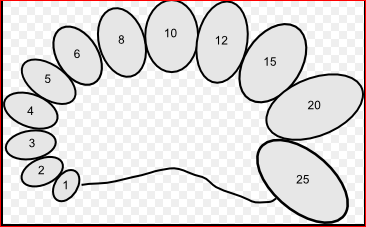
© Filip em (Travail personnel) CC BY-SA 3.0, via Wikimedia Commons
Small firm testes suggest hypogonadism or testicular atrophy.
Absence of a testis may indicate previous excision, undescended or retractile.
Identify scrotal swellings:
Determine whether it is possible to get above the swelling. With the patient standing, if it is not possible to define the upper border of a mass in the scrotum then it is likely to be an inguinal hernia.
Note whether the swelling is solid or cystic. Note whether there is a hydrocèle, varicocèle or epididymal cyst. Testing for translucency with a torch will determine whether the mass is cystic or a solid mass. Likely diagnoses are:
Attached to the testis:
Solid (non-translucent): testicular tumour.
Cystic (translucent): hydrocele.
Separate from the testis:
Solid (non-translucent): chronic epididymitis.
Cystic (translucent): epididymal cyst.
Examine the groin and lymphatics.
Prostate
This is examined by rectal examination to assess:
Size.
Consistency.
Any swelling. A hard lump in either or both lobes suggests a cancer and a biopsy is needed to obtain histological proof.
Presence of the medial sulcus.
Any tenderness.
Neurological examination
Dermatome sensory loss of the perineum or lower limbs and lower limb motor dysfunction suggest possible spinal cord or root pathology.
Trauma or compression of the spinal cord may cause urinary retention if acute, or urgency of micturition if a more chronic process.
Acute compression of either the spinal cord or cauda equina may cause bladder and bowel dysfunction and are both neurosurgical emergencies, requiring urgent treatment to prevent irreversible neurological damage.
The genitourinary history and examination in children
This should involve parents and be done sensitively and carefully. Genitourinary disease in children is more varied and complex (for example, organes génitaux ambigus) than in adults. Developmental aspects may be important in both the history and examination. Aspects of this are covered in other separate articles - for example, Puberté normale et anormale, Antécédents pédiatriques et Examen pédiatrique.
Urinary tract infection in children is an important condition which should be diagnosed early and treated adequately if renal scarring is to be avoided in later life.
Voir l'article séparé Infection urinaire chez les enfants pour plus de détails.
Histoire
In general medical practice the history will usually focus on presenting complaints but, in babies particularly, will involve screening for disease as well. Some of the history overlaps with that for adults but an understanding of normal growth and development, particularly of normal pubertal development, is essential in paediatric practice. Child abuse may present with genitourinary symptoms. When child abuse is suspected the correct procedures should be followed with referral for further assessment and examination.
Examen
Again this will be conducted with a good understanding of normal growth and pubertal development. Sensitive handling is essential and, broadly speaking, intrusive and intimate examinations are rarely appropriate. Ultrasound and other investigative techniques can now be used to assess internal organs. Inspection is often all that is required.
Mises à jour exclusives pour les professionnels de la santé
Restez informé des dernières mises à jour cliniques, des perspectives professionnelles et des conseils fondés sur des preuves. La newsletter Patient Pro sélectionne des contenus essentiels pour les professionnels de santé—livrés directement dans votre boîte de réception.
En vous abonnant, vous acceptez notre Politique de confidentialité. Vous pouvez vous désabonner à tout moment. Nous ne vendons jamais vos données.
Lectures complémentaires et références
- Whitfield HN; ABC of urology: Urological evaluation. BMJ. 2006 Aug 26;333(7565):432-5.
- Urological cancers - recognition and referral; NICE CKS, February 2021 (UK access only)
- Infection urinaire chez les moins de 16 ans : diagnostic et prise en charge; Directive NICE (juillet 2022)
- Infections Sexuellement Transmissibles en Soins Primaires; Royal College of General Practitioners and British Association for Sexual Health and HIV (2013)
À propos de l'auteurVoir la biographie complète

Dr Hayley Willacy, FRCGP
Médecin généraliste, Auteur médical
MBChB (1992), DRCOG, DFFP, MRCOG (Part 1) MRCGP (2007), DFSRH (2013), MSc - medical education (2020)
Le Dr Hayley Willacy était médecin généraliste au NHS travaillant dans le nord-ouest de l'Angleterre, qui a pris sa retraite de la pratique clinique en 2022 après 30 ans.
À propos du critiqueVoir la biographie complète

Dr Philippa Vincent, MRCGP
Médecin généraliste, Auteur médical
MB BS, Bsc, MRCGP (2000), DCH, DFSRH, DRCOG
Dr Philippa Vincent est un médecin généraliste du NHS travaillant dans le nord de Londres.
Historique de l'article
Les informations sur cette page sont rédigées et examinées par des cliniciens qualifiés.
Article également disponible en Anglais, Allemand, Espagnol, Français, Italien, Portugais, Hindi, Hébreu, Arabe, and Suédois.
Prochaine révision prévue : 26 janv. 2028
27 janv. 2025 | Dernière version

Demandez, partagez, connectez-vous.
Parcourez les discussions, posez des questions et partagez vos expériences sur des centaines de sujets de santé.

Vous ne vous sentez pas bien ?
Évaluez vos symptômes en ligne gratuitement
Plus dans l'histoire et l'examen
- Examen abdominal
- Masses abdominales
- Pose de cathéters urinaires
- Problèmes congénitaux de l'oreille
- Certification de décès
- Maladies et différents groupes ethniques
- Hématospermie
- Souffles cardiaques chez les enfants
- Spasme hémifacial
- Syndrome de Horner
- Hyperhidrose
- Douleur au genou
- Douleur lombaire et sciatique
- Tachycardies à complexes étroits
- Terreurs nocturnes et parasomnies
- Obésité chez les enfants
- Pied douloureux
- Dermatite séborrhéique
- Examen du bébé de six semaines
- Trouble somatoforme