Right upper quadrant pain
Upper right abdominal pain
Peer reviewed by Dr Hayley Willacy, FRCGP Last updated by Dr Philippa Vincent, MRCGPLast updated 16 Apr 2026
Meets Patient’s editorial guidelines
- DownloadDownload
- Share
- Language
- Discussion
- Audio Version
- Add to preferred sources on Google
Right upper quadrant (RUQ) pain is pain located in the upper part of the abdomen on your right-hand side. There are many causes of RUQ pain.
At a glance
The right upper quadrant is the upper right section of your tummy, under the ribs.
Your liver, gallbladder, and part of your pancreas or kidney are in this area.
Common causes of pain include gallstones, shingles, and problems with your gut or pancreas.
Treatment for right upper quadrant pain depends on the cause.
See a doctor urgently if you have very severe pain or your skin has turned yellow.
Key points
Right upper quadrant pain is felt in the upper right section of the abdomen, under the ribs, and may radiate to the back or shoulder. It can be sharp, dull, or crampy.
Common cause include gallstones, kidney stones, shingles, hepatitis, and pancreatitis, however there are many other possible causes.
Treatment for RUQ pain depends on the cause but may include antibiotics, dietary changes, pain relief, and surgery.
Where is my right upper quadrant?
The right upper quadrant is a section of your tummy (abdomen) on the upper right hand side.
Look down at your tummy, and mentally divide the area from the bottom of your ribs down to your pubic hair into four quarters. The quarter on your right side closest to your ribs is your RUQ.
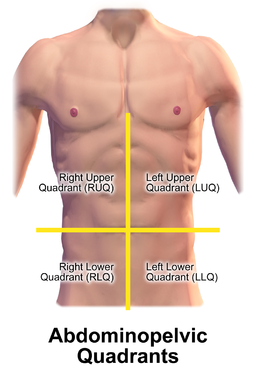
© By Blausen.com staff (2014). “Medical gallery of Blausen Medical 2014”. WikiJournal of Medicine 1 (2). DOI:10.15347/wjm/2014.010. ISSN 2002-4436
Abdominal Quadrant Regions
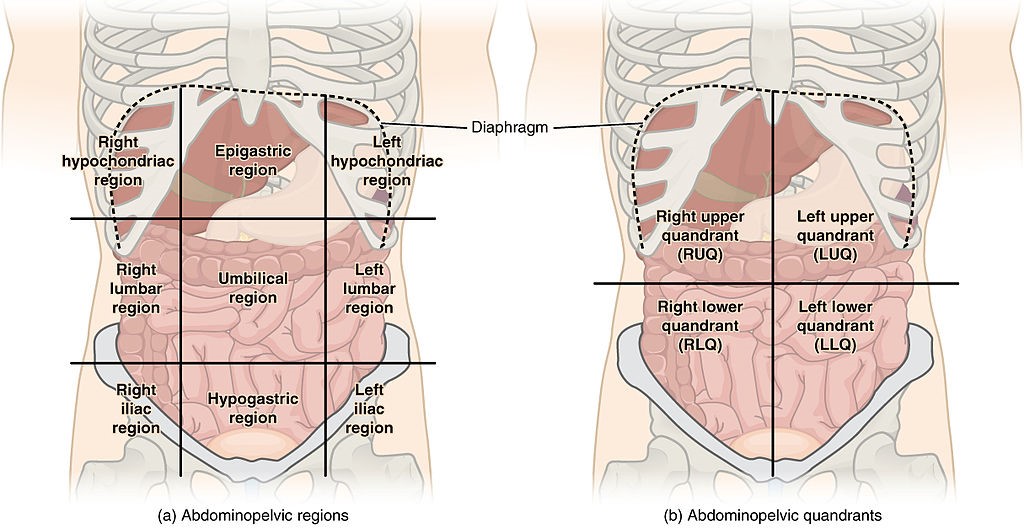
© OpenStax, CC BY 3.0, via Wikimedia Commons
Which organs are in my right upper quadrant?
The organs within your right upper quadrant are your:
Liver.
Gallbladder.
Duodenum and some other parts of your large and small bowel.
Right kidney (at the back behind the other organs).
Part of the pancreas.
The aorta.
There are also the skin and nerves of that area of your abdomen.
What causes right upper quadrant pain?
In adults, the most common causes of right upper quadrant pain are:
Gallstones.
Shingles.
Peptic ulcers - ulcers in the upper part of the guts.
Gut problems (problems affecting the bowel).
Pancreatitis.
These causes are discussed in detail below.
Gallstones and gallbladder problems
Gallstones can block the bile duct, causing biliary colic – a severe, crampy pain in the right upper abdomen, often worse after eating fatty meals.
The pain may spread to the back and shoulders.
An infection may develop, called cholecystitis, which causes more persistent RUQ pain along with a high temperature.
Shingles
Shingles can cause pain in the right upper abdomen because it affects the nerves in that area.
The pain is usually on one side of the body, under the ribs or around to the back, in a stripe-like pattern.
It often feels burning, sharp, or tingly, and the skin can be sore to touch.
A blistering rash usually appears a few days later in the same area.
Some people find they continue to get a pain long after the rash of shingles has gone. This is called postherpetic neuralgia.
Many people get the shingles rash without significant pain.
Liver problems
The liver takes up a large part of your right upper quadrant but it doesn't often cause pain. Causes of pain from the liver include:
Hepatitis (A, B, and C). This will usually result in jaundice and a fever and feeling generally unwell in addition to some pain in that area. Pain is not necessarily a feature.
Abscess. This is a collection of pus causing pain, tenderness and fever.
Alcoholic liver disease. Too much alcohol can damage your liver, which may affect its function, turn your skin yellow (jaundice) and give you RUQ pain.
Liver cancer. This can start in the liver or have spread from other cancers. The liver may enlarge in certain blood cancers, such as lymphomas or leukaemias, and this can cause discomfort.
Gut problems
Several problems in your bowel can give you pain in the right upper quadrant. These include:
Duodenal ulcer. Pain usually starts a few hours after eating and may improve with antacids. It can gradually worsen and, in severe cases, you may vomit blood. This is an emergency - it is important to go to hospital straight away.
Gastroenteritis. Infections in your gut tend to give you pain all over your abdomen, typically more in the middle but occasionally the pain may be in the RUQ area. It is usually associated with diarrhoea and/or being sick (vomiting). You may have a mild fever.
Indigestion. This can give you a pain in the upper part of your abdomen, along with bloating and acid reflux.
Crohn's disease and ulcerative colitis. These long-term conditions can cause pain anywhere in the abdomen. They usually cause loose stools, sometimes with blood.
Pain coming from the pancreas
The pancreas sits in the upper middle of the abdomen and helps digest food and control blood sugar. Pain in the pancreas can be caused by:
Pancreatitis (inflammation). This can cause right upper quadrant pain, nausea, and vomiting. Pain may be felt in the middle or on the right. In acute pancreatitis there is usually also a fever and you often feel very unwell.
Pancreatic cancer. This can cause right upper quadrant pain or back pain but it often causes few symptoms until it is advanced.
Pain coming from the aorta
The aorta is the main blood vessel that carries blood from the heart through the abdomen to the rest of the body. Pain coming from the aorta can be caused by:
Aortic aneurysm. The aorta becomes swollen and weakened and may cause abdominal or back pain if it starts to leak.
Aortic dissection. The aorta can develop a tear in a weakened area of the lining of the aorta. This causes severe pain in the abdomen, back or chest.
Aortic rupture. The aorta bursts, causing very severe pain in the abdomen, back or chest, and feeling very unwell.
Any pain which is suspected to come from the aorta is a medical emergency and needs immediate treatment.
What are the other possible causes?
As well as the more common causes already described, there are many other conditions which occasionally cause right upper quadrant pain.
Irritation of the diaphragm. The diaphragm is a dome-shaped muscle at the bottom of the ribs. Pain can be caused by various conditions including a ruptured ectopic pregnancy, pneumonia, or a hernia involving the diaphragm.
Kidney stones and infections.
Kidney stones can cause a severe pain - usually round the back - which occurs in spasms lasting from a few minutes to several hours.
A kidney stone or infection can cause pain anywhere along your urinary tract. So this could be anywhere from your loin, around to the front, the right upper quadrant, or down to the lower part of your abdomen.
It may also be associated with a fever, pain when you wee, or passing urine more frequently.
Heart attack. This usually causes chest pain, but can sometimes cause pain in the right upper quadrant. You would usually feel very unwell, sweaty or short of breath.
Pneumonia. This is an infection in the lung and normally gives you a cough, and a high temperature (fever), with or without breathlessness and pain in your chest. However, if the infection is in the lower part of your right lung, you may feel the pain in your right upper quadrant.
Pleurisy. Can also sometimes give you a pain low down in your chest and it can feel as though it is in your right upper quadrant..
Diabetic ketoacidosis. A serious complication of type 1 diabetes that makes you very unwell generally, but abdominal pain can be one of the symptoms. This is an emergency and required immediate hospital admission.
Addison's disease. A complication of Addison's disease called an Addisonian crisis occasionally can give you abdominal pain. Again you would feel very unwell and this also is also a medical emergency.
Pregnancy-related liver problems. Rare complications in pregnancy can cause right upper quadrant pain.
Pelvic problems. Conditions such as pelvic inflammatory disease or ovarian cysts can sometimes cause pain that is felt higher up in the abdomen.
Budd-Chiari syndrome. This is a rare condition where blood flow out of the liver is blocked.
These listed causes are not exhaustive, and many other conditions can occasionally cause pain in the right upper quadrant.
What causes right upper quadrant pain in pregnancy?
During pregnancy, all of the above conditions can occur but there are some specific pregnancy-related causes of pain in the right upper quadrant.
Ectopic pregnancy. This is where the pregnancy is developing outside of the womb, usually in one of the Fallopian tubes. It can cause right upper quadrant pain if it bleeds inside the abdomen, and this is a medical emergency.
Pressure from the growing womb. The uterus can press on nearby organs and the diaphragm, causing discomfort.
Indigestion. This is more common in pregnancy and can cause upper abdominal pain.
Urinary tract infections (UTIs). Pain from UTIs can appear different during pregnancy because of the changes in positions of your organs due to the growing womb. They can occasionally cause pain in the right upper quadrant.
What causes right upper quadrant pain in children?
In young children it is often quite difficult for them to show exactly where the pain is. If this is the case, the range of options widens to almost any cause of abdominal pain.
In children common causes include:
Constipation. Hard or infrequent poos can cause right upper quadrant pain (or pain elsewhere in the abdomen).
Anxiety. Stress or worry can sometimes cause pain anywhere in the abdomen.
Mesenteric adenitis. Infection can inflame glands in the abdomen, causing pain, often after a cold.
Appendicitis. Usually this gives pain in the lower right part of the abdomen but it can start around the belly button. Pain may be less clear if the child can’t describe it, or if the appendix has burst.
Pneumonia. Infections of the lower parts of the lungs may cause pain in the right or left upper quadrant.
Gastroenteritis. This infection (usually viral) causes abdominal pain, vomiting, and diarrhoea.
When to see a doctor for right upper quadrant pain
If you have a pain which doesn't settle, you will probably need to see a health professional to help work out the cause.
See a doctor urgently if:
Your skin has turned yellow (this is called jaundice).
Your wee has gone darker and your poo lighter (this suggests a blockage in the tubes around your liver and gallbladder).
Your pain is very severe.
You have recently lost weight without trying.
You are bringing up (vomiting) blood, or have blood in your poo (including a very dark coloured poo which can be caused by old blood from high up in the gut).
You have a high temperature with shaking (rigors).
You feel short of breath.
How is right upper quadrant pain diagnosed?
A doctor will be able to get a reasonable idea of the cause for the pain by:
Asking you some questions about where the pain is and what it feels like.
Physically examining you by feeling your abdomen in the area you have the pain.
Examining other parts of your body, if needed, such as the rest of your abdomen and your chest.
Are tests needed?
You may be asked to provide a sample of urine to check for blood, glucose (sugar) and other abnormalities. You may need further tests, depending on what the doctor thinks is causing the pain.
Possible tests might include:
Blood tests to check the function of your liver, and to look for signs of inflammation, infection, or other potential causes.
An ultrasound scan to look for common conditions such as gallstones.
Occasionally a chest X-ray might be needed to rule out a problem in your lungs, such as infection.
Referral might be needed for:
A look into your stomach and upper bowel with a camera (endoscopy) and other scans and 'scopes'.
A endoscopic retrograde cholangiopancreatography (ERCP) to examine your gallbladder and pancreas.
A computerised tomography (CT) scan, to look for abnormalities of the pancreas or kidneys.
It is very unlikely that you would need all these tests - tests will be chosen depending on the likely cause of the pain after the examination.
What if no cause is found after tests?
If a serious cause has been ruled out, this is reassuring, but the pain may continue in some cases.
Sometimes it is hard to find a cause - for example, bowel spasm in a condition like irritable bowel syndrome may cause right upper quadrant pain and this can not be shown on tests.
It is also possible for there to be pain that is caused by "mistakes" in the signals your nerves are sending to your brain. This can cause "chronic" (ongoing) pain in various parts of your abdomen without any underlying medical cause.
Treatment for right upper quadrant pain
The treatment for RUQ pain depends on the cause. Treatments for a few of the common causes are briefly discussed below.
Gallstones. In some cases symptoms are not very troublesome and can be managed by sticking to a low-fat diet only. Many people choose to have their gallbladder removed, in an operation called a cholecystectomy. This can usually be done by keyhole (laparoscopic) surgery.
Cholecystitis is treated initially with antibiotics, usually in hospital via injections or a drip (intravenous antibiotics). Once the infection has been treated, a cholecystectomy is usually advised.
Shingles. The pain and rash settle on their own in time, but some people may be advised to take an antiviral tablet to help reduce the risk of long-term nerve pain after shingles. Also, some people may need medication for a few weeks or months after the infection to manage their long-term pain.
Kidney infections are treated with antibiotics. Mild infections can be treated with antibiotics at home. If you are very unwell you may need admission to hospital for intravenous antibiotics and fluids.
Kidney stones. Small kidney stones pass on their own eventually; you will need to drink plenty of fluids. Larger kidney stones may need one of a number of procedures done to break them up or remove them altogether.
A duodenal ulcer is usually treated with acid-suppressing medication, as is indigestion.
What is the outlook?
This depends on the cause of the pain. Your doctor should be able to give you an idea of the outlook once a diagnosis has become clear.
Patient picks for Abdominal pain
Digestive health
Left upper quadrant pain
Left upper quadrant (LUQ) pain is pain located in the upper part of the abdomen on your left-hand side. There are many causes of LUQ pain.
by Dr Hayley Willacy, FRCGP

Digestive health
Right lower quadrant pain
Right lower quadrant (RLQ) pain is abdominal pain that is mainly in the lower half on the right-hand side. There are many causes of RLQ pain.
by Dr Hayley Willacy, FRCGP
Frequently asked questions
Can stress or anxiety lead to right upper quadrant pain?
Yes, stress or worry can sometimes cause pain anywhere in the abdomen, including the right upper quadrant. This is especially noted as a cause of abdominal pain in children.
If I have right upper quadrant pain, does that mean I definitely have a problem with my liver?
Not necessarily. While the liver is a major organ in the right upper quadrant, many other organs and conditions can cause pain in this area. These include problems with the gallbladder, bowels, pancreas, kidney, or even issues like shingles or a heart attack. The liver itself doesn't often cause pain unless there's an underlying condition like hepatitis, an abscess, or alcoholic liver disease.
Could diet influence right upper quadrant pain?
Yes, certain dietary choices can influence right upper quadrant pain, particularly if gallstones are the cause. Eating fatty meals can often worsen the severe, crampy pain associated with gallstones. In some cases, managing gallstone symptoms may involve sticking to a low-fat diet.
Is it possible for pain from my heart or lungs to be felt in my right upper quadrant?
Yes, it is possible for pain from conditions affecting your heart or lungs to be felt in your right upper quadrant. A heart attack, though typically causing chest pain, can sometimes present as pain in this area. Similarly, if there's an infection like pneumonia in the lower part of your right lung, or inflammation of the lining of the lung (pleurisy) low down in your chest, it can be perceived as right upper quadrant pain.
What if I experience right upper quadrant pain but doctors can't find a specific cause?
If serious causes have been ruled out, it's reassuring, but the pain may still continue. Sometimes, conditions like irritable bowel syndrome (IBS), which causes bowel spasms, can lead to right upper quadrant pain that doesn't show up on standard tests. It's also possible for chronic pain to occur due to "mistakes" in nerve signals, where the brain receives pain messages without an identifiable underlying medical cause.
Further reading and references
- Kim JS; Acute abdominal pain in children. Pediatr Gastroenterol Hepatol Nutr. 2013 Dec;16(4):219-24. doi: 10.5223/pghn.2013.16.4.219. Epub 2013 Dec 31.
- Cartwright SL, Knudson MP; Diagnostic imaging of acute abdominal pain in adults. Am Fam Physician. 2015 Apr 1;91(7):452-9.
- Gallstones; NICE CKS, June 2024 (UK access only)
- Cholecystitis - acute; NICE CKS, July 2021 (UK access only)
About the authorView full bio

Dr Philippa Vincent, MRCGP
General Practitioner, Medical Author
MB BS, Bsc, MRCGP (2000), DCH, DFSRH, DRCOG
Dr Philippa Vincent is an NHS GP working in North London.
About the reviewerView full bio

Dr Hayley Willacy, FRCGP
General Practitioner, Medical Author
MBChB (1992), DRCOG, DFFP, MRCOG (Part 1) MRCGP (2007), DFSRH (2013), MSc - medical education (2020)
Dr Hayley Willacy was an NHS GP working in northwest England, who retired from clinical practice in 2022 after 30 years.
Article history
The information on this page is written and peer reviewed by qualified clinicians.
Article also available in English, German, Spanish, French, Italian, Portuguese, Hindi, Hebrew, Arabic, and Swedish.
Next review due: 16 Oct 2030
16 Apr 2026 | Latest version
Join the conversation
Share your thoughts or experiences with others in our patient communities.

Ask, share, connect.
Browse discussions, ask questions, and share experiences across hundreds of health topics.

Feeling unwell?
Assess your symptoms online for free
Sign up to the Patient newsletter
Your weekly dose of clear, trustworthy health advice - written to help you feel informed, confident and in control.
By subscribing you accept our Privacy Policy. You can unsubscribe at any time. We never sell your data.